
No products
Product successfully added to your shopping cart
There are 0 items in your cart. There is 1 item in your cart.
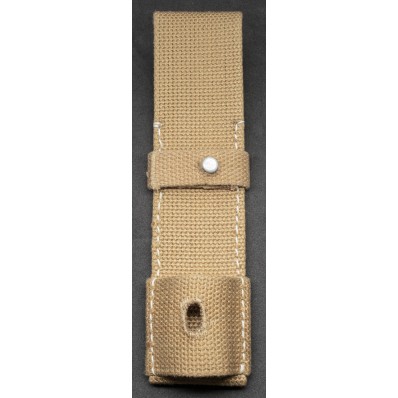


Canvas Bayonet Frog for the K98 Mauser Seitengewehr 84/98
New
Canvas bayonet frog for the K98 Mauser Seitengewehr 84/98, with reinforced construction and belt loop. Used to attach the bayonet scabbard to the equipment belt, it supported the metal scabbard and kept the bayonet stable during marching, service and field use.
Warning: Last items in stock!
- Satisfied or refunded: we guarantee 100% secure protection on your purchases
- Free return: return your order free of charge within 30 days from receipt
- Secure payments: pay securely online with PayPal or credit cards

More info
Canvas K98 Mauser Bayonet Frog – carrier for the Seitengewehr 84/98
The canvas bayonet frog for the K98 Mauser was a field equipment accessory used to carry the Seitengewehr 84/98, the bayonet most commonly associated with the German Karabiner 98k. The frog connected the bayonet’s metal scabbard to the soldier’s equipment belt, allowing the weapon to be worn securely at the side.
The Seitengewehr 84/98 was carried in its steel scabbard, which was suspended from the belt through the frog. This arrangement kept the bayonet accessible while preventing the scabbard from moving excessively during marching or field activity. Although small, the frog was an essential link between the bayonet, scabbard and personal equipment system.
The canvas construction provided a practical alternative to leather bayonet frogs. Canvas reduced weight and leather use while still offering strength when reinforced at stress points. Strong stitching, a durable belt loop and a shaped opening were needed to carry the combined weight of the metal scabbard and bayonet without tearing or stretching.
From a technical standpoint, the frog had a straightforward but important function. The upper loop passed over the belt, while the lower section held the scabbard’s suspension stud or fitting. This kept the scabbard from slipping free and helped control movement while walking or running. The opening for the scabbard stud was one of the most heavily stressed areas and was often reinforced by additional layers or dense stitching.
The Karabiner 98k was the main German service rifle of the Second World War, and the Seitengewehr 84/98 formed its standard edged accessory. Even as bayonet use in combat became less common, the bayonet remained part of the soldier’s issued equipment and continued to be carried with the belt kit.
Historical bayonet frogs could vary in material, colour, stitching, reinforcement layout, opening shape and construction details. Canvas examples are especially connected with practical wartime production and the wider use of textile materials where leather could be reduced or substituted.
Collector’s note: the word “frog” refers to the carrier for the scabbard, not the bayonet itself. In German, terms such as Seitengewehrtasche or Koppelschuh describe the item more precisely: a suspension piece that holds the bayonet scabbard on the belt.
30 other products in the same category:

Customers who bought this product also bought:
Field and Personal Equipment
- Germany
- Uniforms
- Medals, Orders and Decorations
- Badges and Pins
- ID Tags
- Arm Shields
- Helmets
- Helmet Decals
- Visor Caps and Hats
- Cap and Helmet Badges
- Collar Tabs Badges
- Collar Tabs, Shoulder Boards and Epaulettes
- Arm Bands
- Division Cuff Titles
- Buckles And Belts
- Buttons For Uniforms
- Stamps
- Gorgets
- Rings
- SS Honour Ring in 925 Silver - Collector's Set
- Poletops
- Flags
- Daggers and Knives (Ornamental)
- Field Marshal Batons
- Field and Personal Equipment
- Service Watches
- Presentation Cases
- Documents and Award Letters
- Busts, Eagles, Lighters and Miscellaneous
- Croatian and Ustasha Militaria
- Denazified Articles
- Commemorative Necklaces
- Spare Parts, Small Parts and Accessories
- Italy
- Medals and Decorations
- Brevets And Badges
- Battle Shields and Tags
- Gorgets
- Visor Caps and Hats
- Cap and Helmet Badges
- Helmets Decals
- Friezes for Collar Tabs
- Collar Tabs, Shoulder Boards and Epaulettes
- Buckles
- Belts
- Buttons For Uniforms
- Rings
- Poletops
- Italian Resistance
- Keyrings
- Wallshields
- Daggers and Knives
- Flags
- Busts and Eagles
- Souvenirs
- Commemorative Necklaces
- Imperial Germany
- Soviet Union
- Other Countries