
No products
Product successfully added to your shopping cart
There are 0 items in your cart. There is 1 item in your cart.
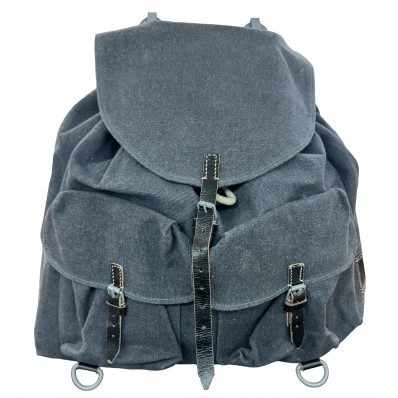


Luftwaffe M31 Rucksack
New
Luftwaffe M31 rucksack made from strong blue-grey canvas, with leather trim, metal buckles, a large main compartment and two front pockets. Used by German air force personnel during WWII to carry personal items, rations, spare clothing and small service equipment.
Warning: Last items in stock!
- Satisfied or refunded: we guarantee 100% secure protection on your purchases
- Free return: return your order free of charge within 30 days from receipt
- Secure payments: pay securely online with PayPal or credit cards

More info
Luftwaffe M31 Rucksack – individual field equipment pack
The Luftwaffe M31 rucksack was an item of individual carrying equipment associated with German air force personnel during the Second World War. Compared with the traditional Tornister, which was more rigid and often fitted with a fur-covered exterior, the M31 rucksack had a softer, more practical and more flexible construction. It was used for carrying personal belongings, spare clothing, rations, small service accessories and other field items required during movement.
The Luftwaffe version is recognizable for its blue-grey canvas, a colour strongly associated with many textile equipment items used by the German air force. The body of the rucksack was made from sturdy canvas, suitable for repeated use, abrasion and field conditions. Leather trim, straps, metal buckles and fastening points reinforced the areas most exposed to wear.
Its layout included a large main compartment for bulkier contents and two external front pockets for smaller items requiring separate storage or quicker access. This arrangement helped organize personal equipment, allowing rations, accessories, tools or private belongings to be carried apart from the main load.
The Luftwaffe included far more than pilots and aircrew. Its personnel also covered mechanics, ground staff, logistics services, anti-aircraft artillery units, security detachments, training formations, field divisions and parachute units. A strong and roomy rucksack could therefore be used in many settings, including airfields, Flak positions, mobile units, training schools and transfers between operational areas.
From a technical perspective, the M31 rucksack offered a more adaptable carrying solution than rigid packs. Canvas construction allowed the pack to conform more easily to its contents, while the outer pockets improved practical organization. Historical variants could differ in shoulder straps, reinforcement details, leather fittings and attachment systems, depending on the maker, production period and field modifications.
Collector’s note: one detail often observed on surviving examples concerns the shoulder straps. Not all M31 rucksacks used the same strap configuration; in some cases carrying systems were locally completed or adapted by unit saddlers or cobblers, using leather, canvas or webbing.
30 other products in the same category:

Customers who bought this product also bought:
Field and Personal Equipment
- Germany
- Uniforms
- Medals, Orders and Decorations
- Badges and Pins
- ID Tags
- Arm Shields
- Helmets
- Helmet Decals
- Visor Caps and Hats
- Cap and Helmet Badges
- Collar Tabs Badges
- Collar Tabs, Shoulder Boards and Epaulettes
- Arm Bands
- Division Cuff Titles
- Buckles And Belts
- Buttons For Uniforms
- Stamps
- Gorgets
- Rings
- SS Honour Ring in 925 Silver - Collector's Set
- Poletops
- Flags
- Daggers and Knives (Ornamental)
- Field Marshal Batons
- Field and Personal Equipment
- Service Watches
- Presentation Cases
- Documents and Award Letters
- Busts, Eagles, Lighters and Miscellaneous
- Croatian and Ustasha Militaria
- Denazified Articles
- Commemorative Necklaces
- Spare Parts, Small Parts and Accessories
- Italy
- Medals and Decorations
- Brevets And Badges
- Battle Shields and Tags
- Gorgets
- Visor Caps and Hats
- Cap and Helmet Badges
- Helmets Decals
- Friezes for Collar Tabs
- Collar Tabs, Shoulder Boards and Epaulettes
- Buckles
- Belts
- Buttons For Uniforms
- Rings
- Poletops
- Italian Resistance
- Keyrings
- Wallshields
- Daggers and Knives
- Flags
- Busts and Eagles
- Souvenirs
- Commemorative Necklaces
- Imperial Germany
- Soviet Union
- Other Countries