
No products
Product successfully added to your shopping cart
There are 0 items in your cart. There is 1 item in your cart.
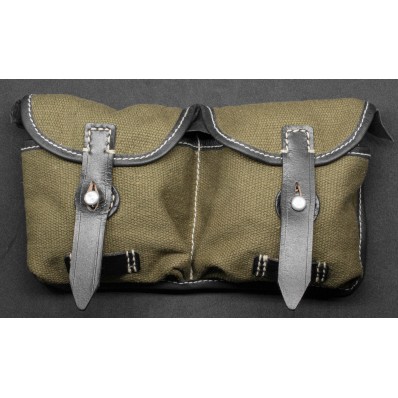


G43 Ammunition Pouches in Olive
New
G43 ammunition pouches in olive canvas, with rear belt loops, closure straps and reinforcements. Designed to carry detachable magazines for the Gewehr 43, they held ready ammunition for the German semi-automatic rifle used by Wehrmacht personnel during the Second World War.
Warning: Last items in stock!
- Satisfied or refunded: we guarantee 100% secure protection on your purchases
- Free return: return your order free of charge within 30 days from receipt
- Secure payments: pay securely online with PayPal or credit cards

More info
G43 Ammunition Pouches in Olive – equipment for the Gewehr 43
The G43 ammunition pouches in olive canvas were part of the equipment used to carry magazines for the Gewehr 43, the German semi-automatic rifle introduced during the Second World War. The G43 was developed to give infantrymen a higher rate of fire than the Karabiner 98k while retaining the standard 7.92×57 mm Mauser cartridge.
The pouches were made from strong olive canvas, offering a light and durable solution for carrying detachable magazines. Canvas was easier to produce than leather, reduced weight and provided sufficient resistance to abrasion and field use. Rear belt loops secured the pouch to the equipment belt, while closure straps kept the magazines in place during marching, movement and service.
The compartments were designed for Gewehr 43 magazines, normally holding 10 rounds. Unlike the Karabiner 98k, which was loaded with stripper clips, the G43 used a detachable magazine, although in practice it could also be reloaded from above with 5-round clips. This made magazine pouches useful for carrying additional ready ammunition.
The Gewehr 43, also known as the G43 or Karabiner 43 / K43, was issued to various Wehrmacht units, including infantry and designated marksmen. Some rifles were fitted with optical sights, making the G43 especially well known in the sniper role. Ammunition pouches were therefore an important accessory when spare magazines were carried in the field.
From a construction standpoint, the pouch had to secure relatively heavy metal magazines. Each compartment needed to prevent excessive movement, impact and accidental loss while still allowing access when required. Historical variants could differ in canvas colour, closure style, stitching, reinforcements, belt loops and materials used at stress points.
The olive colour fits within the range of German textile field equipment, alongside feldgrau, grey-green, tan and simplified late-war material variations. Its subdued shade matched practical field use and blended with other equipment items.
Collector’s note: G43 magazines were detachable, but they were not always changed in the modern manner. Often the magazine remained in the rifle and was refilled using 5-round stripper clips. Spare magazines therefore served as an additional reserve, making G43 pouches an interesting accessory linked to the transition from traditional bolt-action rifles to modern semi-automatic systems.
30 other products in the same category:

Customers who bought this product also bought:
Field and Personal Equipment
- Germany
- Uniforms
- Medals, Orders and Decorations
- Badges and Pins
- ID Tags
- Arm Shields
- Helmets
- Helmet Decals
- Visor Caps and Hats
- Cap and Helmet Badges
- Collar Tabs Badges
- Collar Tabs, Shoulder Boards and Epaulettes
- Arm Bands
- Division Cuff Titles
- Buckles And Belts
- Buttons For Uniforms
- Stamps
- Gorgets
- Rings
- SS Honour Ring in 925 Silver - Collector's Set
- Poletops
- Flags
- Daggers and Knives (Ornamental)
- Field Marshal Batons
- Field and Personal Equipment
- Service Watches
- Presentation Cases
- Documents and Award Letters
- Busts, Eagles, Lighters and Miscellaneous
- Croatian and Ustasha Militaria
- Denazified Articles
- Commemorative Necklaces
- Spare Parts, Small Parts and Accessories
- Italy
- Medals and Decorations
- Brevets And Badges
- Battle Shields and Tags
- Gorgets
- Visor Caps and Hats
- Cap and Helmet Badges
- Helmets Decals
- Friezes for Collar Tabs
- Collar Tabs, Shoulder Boards and Epaulettes
- Buckles
- Belts
- Buttons For Uniforms
- Rings
- Poletops
- Italian Resistance
- Keyrings
- Wallshields
- Daggers and Knives
- Flags
- Busts and Eagles
- Souvenirs
- Commemorative Necklaces
- Imperial Germany
- Soviet Union
- Other Countries