
No products
Product successfully added to your shopping cart
There are 0 items in your cart. There is 1 item in your cart.
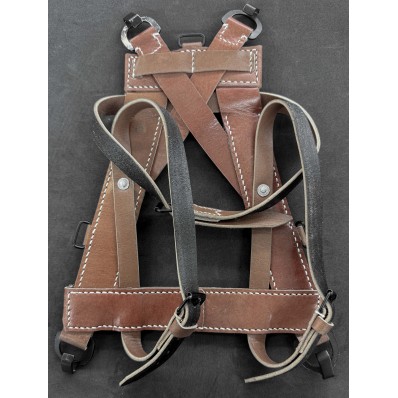


All-Leather A-Frame
New
German WWII A-frame made entirely from leather, used as an auxiliary carrier for combat equipment. Attached to the Y-straps and belt, it allowed the soldier to carry a Zeltbahn, mess tin, blanket, utility bag and small field items in a compact, stable arrangement.
Warning: Last items in stock!
- Satisfied or refunded: we guarantee 100% secure protection on your purchases
- Free return: return your order free of charge within 30 days from receipt
- Secure payments: pay securely online with PayPal or credit cards

More info
German WWII All-Leather A-Frame – assault frame for individual field equipment
The German A-frame was an auxiliary carrying frame used with individual field equipment during the Second World War. Its triangular shape, resembling the letter “A”, allowed essential field items to be carried on the back and connected to the Y-strap load-bearing system and equipment belt.
The all-leather version has a more rigid and structured construction than canvas examples fitted with leather straps. Leather was used not only for the straps and end pieces, but also for the main carrying frame, giving the system high tensile strength, stability and durability at stress points. Buckles, hooks, stitching and attachment fittings completed the structure and allowed it to connect securely to the rest of the equipment.
The A-frame was used to carry light but essential field items such as the Zeltbahn, mess tin, rolled blanket, A-frame bag, rations and small field accessories. It was not a rucksack in the traditional sense, but a support structure. Its purpose was to organize a compact combat load close to the body, avoiding the bulk of a full rucksack or Tornister while still keeping necessary equipment available.
From a technical standpoint, the triangular shape distributed the load over the upper back. Upper and lower attachment points integrated the frame with the soldier’s carrying system, while the straps secured the items attached to it. Leather provided stiffness and durability, though it also showed wear clearly: moisture, repeated bending and tension left marks around buckles, holes, stitching and hook areas.
Historically, the A-frame belonged to German WWII combat equipment and reflected the need for a reduced but practical load-carrying system for short marches, combat movement and forward service. Variants could differ in leather colour, thickness, stitching pattern, hook shape and fastening details depending on maker, production period and material availability.
Collector’s note: the A-frame is sometimes mistaken for a small backpack, but its function was different. By itself it was only the carrying structure; with a Zeltbahn, mess tin, blanket or A-frame bag attached, it became a compact combat load. On leather versions, creases and tension marks at the attachment points clearly show how the load was secured.
30 other products in the same category:

Customers who bought this product also bought:
Field and Personal Equipment
- Germany
- Uniforms
- Medals, Orders and Decorations
- Badges and Pins
- ID Tags
- Arm Shields
- Helmets
- Helmet Decals
- Visor Caps and Hats
- Cap and Helmet Badges
- Collar Tabs Badges
- Collar Tabs, Shoulder Boards and Epaulettes
- Arm Bands
- Division Cuff Titles
- Buckles And Belts
- Buttons For Uniforms
- Stamps
- Gorgets
- Rings
- SS Honour Ring in 925 Silver - Collector's Set
- Poletops
- Flags
- Daggers and Knives (Ornamental)
- Field Marshal Batons
- Field and Personal Equipment
- Service Watches
- Presentation Cases
- Documents and Award Letters
- Busts, Eagles, Lighters and Miscellaneous
- Croatian and Ustasha Militaria
- Denazified Articles
- Commemorative Necklaces
- Spare Parts, Small Parts and Accessories
- Italy
- Medals and Decorations
- Brevets And Badges
- Battle Shields and Tags
- Gorgets
- Visor Caps and Hats
- Cap and Helmet Badges
- Helmets Decals
- Friezes for Collar Tabs
- Collar Tabs, Shoulder Boards and Epaulettes
- Buckles
- Belts
- Buttons For Uniforms
- Rings
- Poletops
- Italian Resistance
- Keyrings
- Wallshields
- Daggers and Knives
- Flags
- Busts and Eagles
- Souvenirs
- Commemorative Necklaces
- Imperial Germany
- Soviet Union
- Other Countries