
No products
Product successfully added to your shopping cart
There are 0 items in your cart. There is 1 item in your cart.
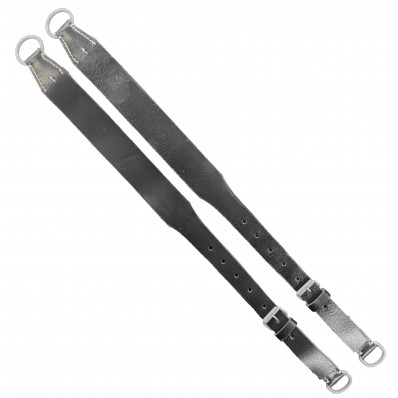


Leather Straps for M31 Rucksacks
New
Leather straps for German M31 WWII rucksacks, fitted with metal buckles and adjustment holes. Used for carrying the M31 rucksack and connecting it to the soldier’s equipment, they helped keep the pack stable during marching, transfers and field service.
Warning: Last items in stock!
- Satisfied or refunded: we guarantee 100% secure protection on your purchases
- Free return: return your order free of charge within 30 days from receipt
- Secure payments: pay securely online with PayPal or credit cards

More info
Leather Straps for German M31 WWII Rucksacks – carrying accessories for the M31 Rucksack
The leather straps for German M31 rucksacks were essential components of the carrying system used with the M31 Rucksack, one of the practical soft packs associated with German field equipment during the Second World War. Their purpose was to attach the pack to the soldier’s body or equipment system, helping distribute the load securely during marching, movement and field service.
Made from sturdy leather, the straps were fitted with metal buckles, adjustment holes and attachment points that allowed the rucksack to be adapted to the wearer’s build, clothing layers and carried load. Leather was used in high-stress areas because it provided strength, controlled flexibility and durability. The buckles allowed length adjustment, while the punched holes held the selected setting under tension.
The M31 rucksack differed from the traditional Tornister by using a softer and more flexible construction. While the Tornister was more rigid and often had a fur-covered flap, the M31 rucksack used a canvas body with leather fittings. Such a pack required strong straps to keep the load close to the body without excessively restricting movement. Depending on the configuration, the leather straps could serve as shoulder straps or as connecting elements for the broader load-bearing equipment system.
The M31 rucksack was used to carry spare clothing, rations, personal belongings, field accessories and small service items. In this role, the leather straps were exposed to constant strain: the weight of the pack, friction against the uniform, moisture, repeated bending and tension at the attachment points. Stitching, buckles, adjustment holes and leather thickness were therefore central to the reliability of the whole carrying arrangement.
From a technical perspective, these straps reflect the construction logic of German wartime equipment: leather at the strongest stress points, metal hardware for adjustment and a modular form that allowed different carrying configurations. They could be used with M31 rucksacks carried by infantry, mountain troops, mobile units or service personnel, wherever a stable and adjustable pack system was required.
Collector’s note: original M31 rucksack straps can vary in leather colour, thickness, buckle style and terminal shape. These differences were influenced by maker, production period, material availability and field repairs, which explains why straps of the same basic type may show noticeable construction variations.
30 other products in the same category:

Customers who bought this product also bought:
Field and Personal Equipment
- Germany
- Uniforms
- Medals, Orders and Decorations
- Badges and Pins
- ID Tags
- Arm Shields
- Helmets
- Helmet Decals
- Visor Caps and Hats
- Cap and Helmet Badges
- Collar Tabs Badges
- Collar Tabs, Shoulder Boards and Epaulettes
- Arm Bands
- Division Cuff Titles
- Buckles And Belts
- Buttons For Uniforms
- Stamps
- Gorgets
- Rings
- SS Honour Ring in 925 Silver - Collector's Set
- Poletops
- Flags
- Daggers and Knives (Ornamental)
- Field Marshal Batons
- Field and Personal Equipment
- Service Watches
- Presentation Cases
- Documents and Award Letters
- Busts, Eagles, Lighters and Miscellaneous
- Croatian and Ustasha Militaria
- Denazified Articles
- Commemorative Necklaces
- Spare Parts, Small Parts and Accessories
- Italy
- Medals and Decorations
- Brevets And Badges
- Battle Shields and Tags
- Gorgets
- Visor Caps and Hats
- Cap and Helmet Badges
- Helmets Decals
- Friezes for Collar Tabs
- Collar Tabs, Shoulder Boards and Epaulettes
- Buckles
- Belts
- Buttons For Uniforms
- Rings
- Poletops
- Italian Resistance
- Keyrings
- Wallshields
- Daggers and Knives
- Flags
- Busts and Eagles
- Souvenirs
- Commemorative Necklaces
- Imperial Germany
- Soviet Union
- Other Countries