
No products
Product successfully added to your shopping cart
There are 0 items in your cart. There is 1 item in your cart.
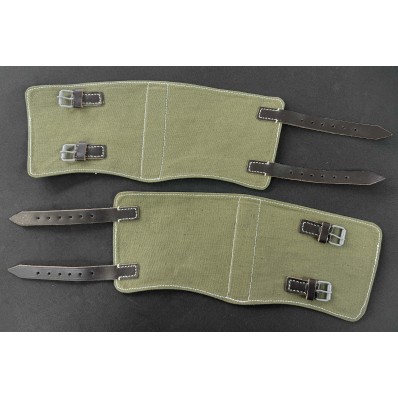


Green Gaiters with Black Leather
New
WWII German green gaiters made from strong canvas, with black leather straps, tabs and lower edging. Worn over low ankle boots, they secured the trouser bottoms and protected the ankle area from mud, dust, debris and abrasion during field service.
- Satisfied or refunded: we guarantee 100% secure protection on your purchases
- Free return: return your order free of charge within 30 days from receipt
- Secure payments: pay securely online with PayPal or credit cards

More info
WWII German Green Gaiters with Black Leather – Gamaschen for low ankle boots
The WWII German green gaiters, known in German as Gamaschen, were worn over low ankle boots to close and protect the lower part of the trousers. Their purpose was practical: they helped keep mud, dust, small stones and field debris out of the boot area, tightened the trouser cuff around the ankle and gave the soldier’s lower-leg equipment a more secure fit during marching and field use.
These gaiters are made from heavy green canvas, with black leather straps, metal buckles and a reinforced lower edge. The combination of canvas and leather provided a practical balance between durability, protection and reduced leather consumption. They were wrapped around the lower leg and fastened with adjustable straps, creating a firm closure over the boot and trouser bottom.
During the war, the use of low ankle boots with gaiters became increasingly common in the German armed forces. This system gradually replaced tall marching boots in many situations, as long boots required significantly more leather. Gamaschen were used by personnel of the Heer, Luftwaffe and Waffen-SS, especially as wartime production needs and material shortages reshaped field equipment issue. Specialist descriptions connect their wider adoption to the conservation of leather and the increasing replacement of jackboots by ankle boots.
From a technical point of view, the gaiters were built for repeated field use, marching, training and operational conditions. The thick canvas resisted abrasion and folding, while the leather straps allowed a stable adjustable closure. The shaped lower edge followed the outline of the boot, helping cover the gap between footwear and trousers. Surviving examples and specialist descriptions often mention leather tabs, black straps, metal hardware and a scalloped or shaped leather-trimmed lower edge.
Collector’s note: German gaiters were more than a small uniform accessory. Their wider use reflects a wartime shift in equipment production: replacing tall leather boots with ankle boots and canvas gaiters reduced leather consumption while preserving ankle coverage, field practicality and protection against mud and debris.
30 other products in the same category:

Customers who bought this product also bought:
Field and Personal Equipment
- Germany
- Uniforms
- Medals, Orders and Decorations
- Badges and Pins
- ID Tags
- Arm Shields
- Helmets
- Helmet Decals
- Visor Caps and Hats
- Cap and Helmet Badges
- Collar Tabs Badges
- Collar Tabs, Shoulder Boards and Epaulettes
- Arm Bands
- Division Cuff Titles
- Buckles And Belts
- Buttons For Uniforms
- Stamps
- Gorgets
- Rings
- SS Honour Ring in 925 Silver - Collector's Set
- Poletops
- Flags
- Daggers and Knives (Ornamental)
- Field Marshal Batons
- Field and Personal Equipment
- Service Watches
- Presentation Cases
- Documents and Award Letters
- Busts, Eagles, Lighters and Miscellaneous
- Croatian and Ustasha Militaria
- Denazified Articles
- Commemorative Necklaces
- Spare Parts, Small Parts and Accessories
- Italy
- Medals and Decorations
- Brevets And Badges
- Battle Shields and Tags
- Gorgets
- Visor Caps and Hats
- Cap and Helmet Badges
- Helmets Decals
- Friezes for Collar Tabs
- Collar Tabs, Shoulder Boards and Epaulettes
- Buckles
- Belts
- Buttons For Uniforms
- Rings
- Poletops
- Italian Resistance
- Keyrings
- Wallshields
- Daggers and Knives
- Flags
- Busts and Eagles
- Souvenirs
- Commemorative Necklaces
- Imperial Germany
- Soviet Union
- Other Countries