
No products
Product successfully added to your shopping cart
There are 0 items in your cart. There is 1 item in your cart.
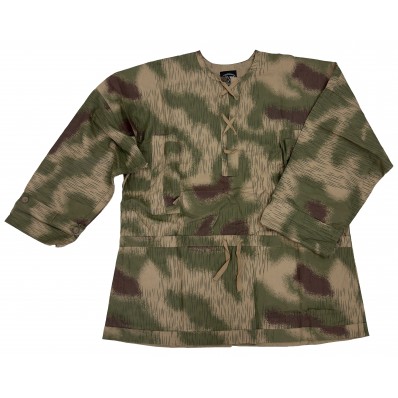


Sumpftarn Sniper Smock
New
Sumpftarn camouflage smock of the Heer in the distinctive “Tan & Water” marsh pattern, featuring a loose pullover construction, laced neck opening, front access openings and adjustable drawcord waist. Developed from the earlier Splittertarn smocks, this pattern became particularly associated with snipers and troops requiring additional concealment during the later years of the Second World War.
Warning: Last items in stock!
- Satisfied or refunded: we guarantee 100% secure protection on your purchases
- Free return: return your order free of charge within 30 days from receipt
- Secure payments: pay securely online with PayPal or credit cards

More info
The Sumpftarn Sniper Smock, historically a form of Tarnhemd, represents one of the most distinctive developments in Heer personal camouflage clothing during the second half of the Second World War. Often described today as the “Tan & Water Sniper Smock,” it belonged to a family of lightweight camouflage oversmock garments intended to be worn directly over the standard field uniform.
Its development followed the experience gained with the earlier Splittertarn Tarnhemd. These garments demonstrated that a loose camouflage layer could effectively cover the highly recognizable field-grey uniform while simultaneously helping to disrupt the outline of the human body.
The most obvious development concerned the camouflage itself. The sharply geometric Splittertarnmuster was replaced by the more sophisticated Sumpftarnmuster, introduced during 1943 and subsequently developed through several variations.
Sumpftarn was itself derived from the earlier Buntfarbenaufdruck 31 camouflage design, but substantially softened its appearance. Over a tan, beige or yellow-brown background were placed areas of green and brown, with the edges of these shapes partially dissolved through characteristic stippling.
Rather than ending abruptly, the coloured areas appeared to fade progressively into the background. This produced a noticeably more organic effect than the hard-edged splinter shapes of the earlier pattern.
The familiar groups of short vertical “rain” strokes were nevertheless retained. These fine lines ran across the larger camouflage shapes and further disturbed the appearance of continuous surfaces.
The resulting pattern was particularly suitable for grassland, woodland edges, brush, marshy vegetation and mixed European terrain, where softer transitions could blend more naturally with the surroundings.
Its distinctive tan background and blurred areas of colour later gave rise to English-language collector terms such as “Tan & Water,” “Marsh Pattern” and “Swamp Pattern.” The German pattern is now generally identified as Sumpftarnmuster.
The garment itself was constructed as a pullover oversmock rather than a conventional button-front field blouse. It was simply pulled over the head and worn over the normal uniform.
Its deliberately oversized cut allowed sufficient room for the Feldbluse and other clothing beneath it. The loose silhouette also had a secondary camouflage purpose, making the recognizable shapes of the shoulders, torso and arms less obvious.
The upper front incorporated a characteristic laced neck opening, allowing sufficient room to put the garment on before tightening it around the neckline.
A separate drawcord at the waist allowed the wearer to gather the large body of the smock closer to the torso. This reduced loose fabric during crawling, movement through vegetation or other strenuous field activity.
Two distinctive vertical access openings were positioned on the front. Their principal purpose was to allow the wearer to reach pockets and equipment on the uniform beneath the smock.
They should therefore be understood primarily as pass-through access openings rather than conventional external pockets. This simple feature greatly improved the practicality of a garment intended to be worn over another complete uniform.
The sleeves were generously cut for the same reason and could easily cover those of the standard Feldbluse. Button-adjustable cuffs allowed the lower sleeves to be tightened around the wrists when necessary.
The Tarnhemd was primarily a camouflage layer, not a replacement for the field uniform itself. Depending on operational requirements, the soldier's equipment could be worn in combination with or over the smock.
This type of Sumpftarn garment has become particularly associated with Heer snipers, hence the widespread modern term “sniper smock.” Concealment was naturally of exceptional importance to a marksman expected to remain stationary while observing or engaging a target.
The combination of camouflage printing and an oversized silhouette offered two different forms of concealment: the colours reduced contrast against the surrounding terrain, while the loose garment helped distort the familiar shape of the human body.
Its usefulness was not necessarily limited exclusively to snipers. Scouts, observers, Panzergrenadiere and other personnel operating in exposed or concealed positions could also benefit from dedicated camouflage clothing.
Several different Sumpftarn smock configurations appeared during the war. Alongside hoodless garments derived conceptually from the earlier Splittertarn Tarnhemd, versions were produced with an integral camouflage hood.
Some examples incorporated a lightweight camouflage face veil attached to the hood. This could be drawn over the wearer's face to reduce the visual contrast of exposed skin, one of the most difficult elements to conceal effectively.
The existence of this feature illustrates how sophisticated individual camouflage had become by the later stages of the war. Camouflage was no longer limited to hiding the colour of the uniform; attention was increasingly paid to the face, head and overall human silhouette.
The camouflage pattern itself also evolved. What collectors generally identify as Sumpftarnmuster 43 retained some of the angular character of the earlier Splittertarn design, although its edges were softened with stippling.
The later Sumpftarnmuster 44 generally displayed still softer and more rounded transitions, further reducing the sharp geometric appearance inherited from the earlier pattern.
These classifications should not be interpreted too rigidly. Wartime production involved numerous manufacturers, different printing methods, varying batches of cloth and the continued use of whatever suitable material was available.
Surviving garments therefore display considerable variation in shade, print definition and construction details, and individual pieces can sometimes contain sections that do not appear perfectly identical.
The Sumpftarn Tarnhemd consequently represents an important stage in German camouflage development. The evolution from the sharply geometric 1931 Splittertarn design towards softer and increasingly blended patterns can be seen directly in the construction and appearance of these later wartime garments.
Historical curiosity: “Tan & Water” was not the contemporary German name for this camouflage pattern. The expression developed later among English-speaking collectors as a convenient description of its distinctive appearance. More fascinating still is the way Sumpftarn evolved directly from the earlier Splittertarn: instead of abandoning the 1931 design completely, its geometric areas were softened, stippled and increasingly blurred, while the familiar vertical rain strokes were retained. Comparing the two patterns side by side therefore provides a visible record of more than a decade of German camouflage development.
Data sheet
| Material | 100% Cotton |
19 other products in the same category:

Customers who bought this product also bought:
Uniforms
- Germany
- Uniforms
- Medals, Orders and Decorations
- Badges and Pins
- ID Tags
- Arm Shields
- Helmets
- Helmet Decals
- Visor Caps and Hats
- Cap and Helmet Badges
- Collar Tabs Badges
- Collar Tabs, Shoulder Boards and Epaulettes
- Arm Bands
- Division Cuff Titles
- Buckles And Belts
- Buttons For Uniforms
- Stamps
- Gorgets
- Rings
- SS Honour Ring in 925 Silver - Collector's Set
- Poletops
- Flags
- Daggers and Knives (Ornamental)
- Field Marshal Batons
- Field and Personal Equipment
- Service Watches
- Presentation Cases
- Documents and Award Letters
- Busts, Eagles, Lighters and Miscellaneous
- Croatian and Ustasha Militaria
- Denazified Articles
- Commemorative Necklaces
- Spare Parts, Small Parts and Accessories
- Italy
- Medals and Decorations
- Brevets And Badges
- Battle Shields and Tags
- Gorgets
- Visor Caps and Hats
- Cap and Helmet Badges
- Helmets Decals
- Friezes for Collar Tabs
- Collar Tabs, Shoulder Boards and Epaulettes
- Buckles
- Belts
- Buttons For Uniforms
- Rings
- Poletops
- Italian Resistance
- Keyrings
- Wallshields
- Daggers and Knives
- Flags
- Busts and Eagles
- Souvenirs
- Commemorative Necklaces
- Imperial Germany
- Soviet Union
- Other Countries