
No products
Product successfully added to your shopping cart
There are 0 items in your cart. There is 1 item in your cart.
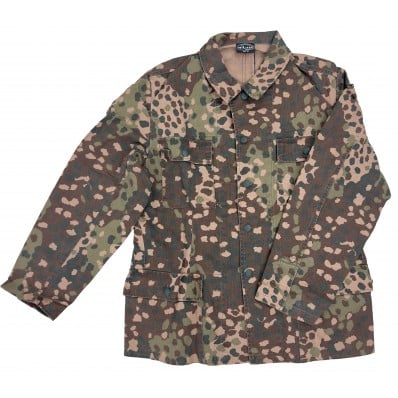


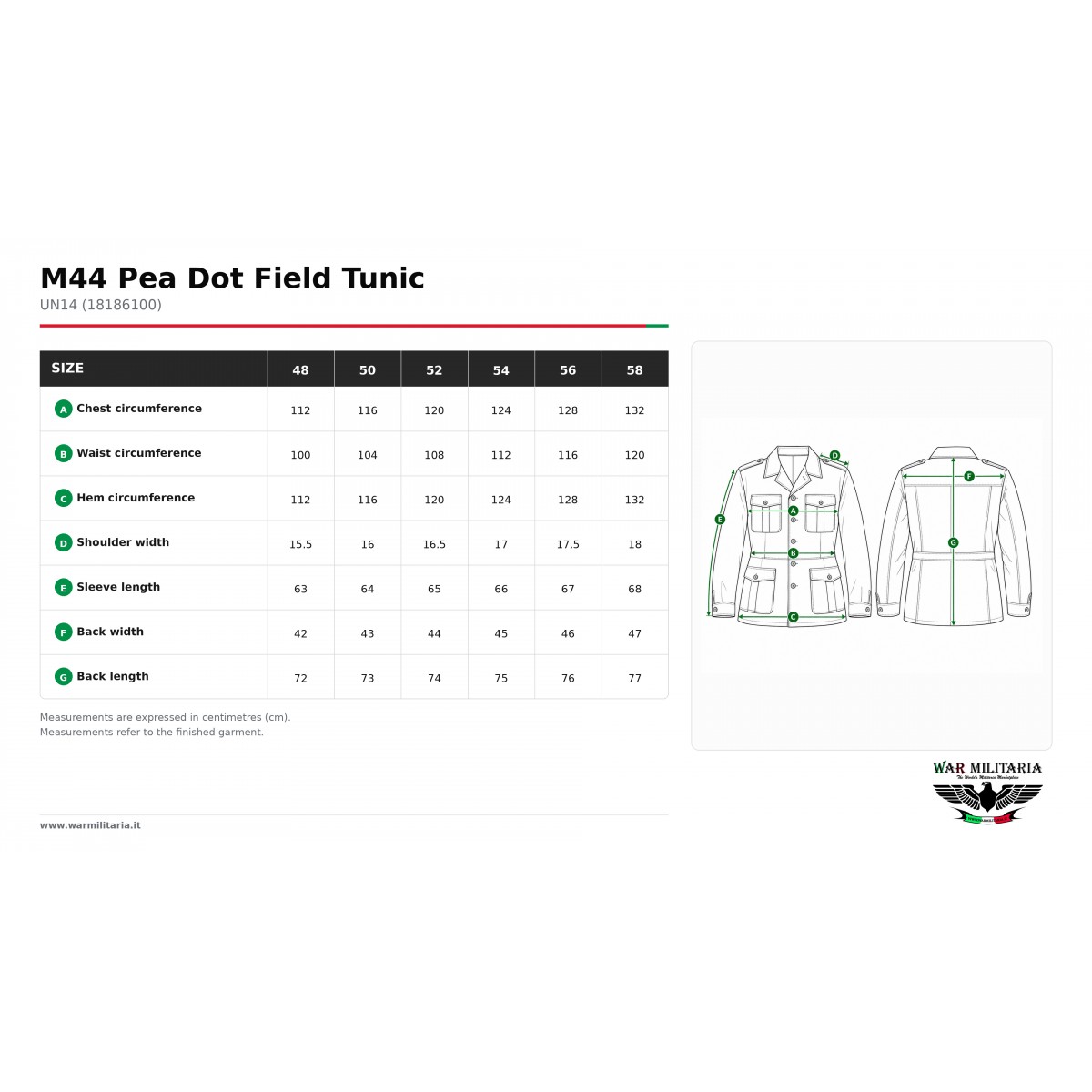
M44 Pea Dot Field Tunic
New
M44 Erbsenmuster field tunic of the Waffen-SS, featuring the distinctive five-colour Pea Dot camouflage, five-button front closure and four unpleated patch pockets with straight flaps. Introduced in 1944 as part of a complete camouflage field uniform, it could be worn on its own or over the standard field uniform, moving beyond the earlier concept of reversible camouflage oversmocks.
- Satisfied or refunded: we guarantee 100% secure protection on your purchases
- Free return: return your order free of charge within 30 days from receipt
- Secure payments: pay securely online with PayPal or credit cards

More info
The M44 Pea Dot Field Tunic, known by collectors and historians as the Erbsenmuster or Erbsentarn Feldbluse, represents one of the most important developments in Waffen-SS camouflage clothing during the closing years of the Second World War.
Introduced in 1944, the new uniform marked a fundamental departure from earlier camouflage clothing.
Previous Waffen-SS camouflage garments were predominantly reversible smocks and overshirts, intended to be pulled over the normal wool field uniform. Erbsenmuster instead formed part of a complete two-piece camouflage field uniform, consisting principally of a tunic and matching trousers.
Camouflage was therefore no longer merely an additional layer worn over the soldier's uniform: the camouflage garment could become the field uniform itself.
The distinctive pattern is now known by several names, including Erbsenmuster, Erbsentarn, Dot 44, Pea Dot and Pea Pattern.
The familiar English name comes from the enormous number of small rounded spots scattered across the fabric, many resembling peas.
The camouflage combined approximately five principal colours, incorporating lighter background areas together with different greens, browns and very dark spots.
Rather than relying on the large geometric shapes found in Splittertarn or the broad organic forms of earlier Waffen-SS camouflage, Erbsenmuster created a highly fragmented surface through hundreds of small dots and irregular patches.
At close range the pattern appears exceptionally busy and complex. At greater distances the numerous small elements begin to merge visually, creating irregular areas of colour that help disrupt the outline of the wearer.
One of the most important concepts behind Erbsenmuster was its intended all-season versatility.
Earlier Waffen-SS camouflage smocks were commonly reversible, with differently coloured sides better suited to spring/summer or autumn conditions.
Erbsenmuster attempted to place green, brown, light and dark seasonal colours within the same camouflage design. The garment therefore did not need to be reversed to expose an alternative seasonal pattern.
The tunic itself was constructed much more like a conventional Feldbluse than the loose camouflage smocks used earlier in the war.
The front was secured by five buttons, while a conventional turn-down collar could be closed at the throat when required.
Four large patch pockets were fitted to the front, with two breast pockets and two lower pockets.
Unlike the pleated pockets of earlier German field tunics, the Erbsenmuster pockets were unpleated and fitted with simple straight-edged flaps. This reflected the broader simplification of German uniform manufacture during the later stages of the war.
The sleeves incorporated button-adjustable cuff openings, allowing the lower sleeve to be tightened around the wrist.
Internally, the tunic was comparatively simple but incorporated reinforcement panels in areas subject to heavier wear.
It also retained the traditional internal system associated with supporting the equipment belt. Fabric straps with several stitched eyelets for belt-support hooks allowed the hook height to be adjusted to the individual wearer.
This transferred some of the weight of the belt and field equipment through the structure of the tunic rather than leaving the loaded belt unsupported around the waist.
A small internal pocket for the individual field dressing was also incorporated, continuing a practical feature found on many German field tunics.
The Erbsenmuster Feldbluse could be worn directly over the service shirt as a lightweight field uniform. In colder conditions it could also be worn over the standard wool Feldbluse.
This gave the garment considerable flexibility: it could function as lightweight combat clothing, a normal field tunic or an additional camouflage layer.
Original uniforms were manufactured from several different types of cloth. Herringbone twill was common, but other cotton, linen and mixed fabrics were also used as wartime production conditions required.
This variety of cloth, combined with differences in printing, created considerable variation in colour and appearanceamong original Erbsenmuster uniforms.
Two authentic tunics produced during the same general period may show noticeably different greens, browns, background shades or print intensity.
Material shortages and increasingly decentralized production during the final stages of the war made perfect standardization even more difficult.
The official approach to insignia was comparatively restrained. The most characteristic insignia associated with the tunic was the Waffen-SS sleeve eagle worn on the left upper arm.
Traditional collar tabs, shoulder boards and other insignia were not normally intended to cover the camouflage uniform in the same manner as a conventional wool service tunic.
Actual field practice, however, was far less consistent. Wartime photographs and surviving original garments show shoulder boards, collar tabs, cuff titles and other insignia being added to camouflage tunics.
Individual alterations were also carried out. Some tunics were shortened, pockets were modified and others received collars removed from older field uniforms, particularly when wearers wished to display traditional rank insignia more clearly.
Erbsenmuster uniforms became increasingly visible during the 1944-1945 period, appearing with Waffen-SS formations on both the Western and Eastern Fronts.
The M44 Erbsenmuster Feldbluse therefore marks a particularly important stage in camouflage uniform development: camouflage was no longer simply an oversmock concealing the real uniform beneath it, but had become an integral part of the soldier's normal combat clothing.
Historical curiosity: one of the most forward-looking features of Erbsenmuster 44 was its attempt to create an effective multi-season camouflage pattern without using reversible fabric. Instead of providing separate green and brown sides, the designers placed greens, browns, lighter background tones and dark spots together in the same complex print. The concept of a single, non-reversible camouflage combat uniform intended to work through several seasons would become extremely common in military uniforms after the war.
Data sheet
| Material | Upper: 100% Cotton Lining: 100% Cotton |
18 other products in the same category:

Customers who bought this product also bought:
Uniforms
- Germany
- Uniforms
- Medals, Orders and Decorations
- Badges and Pins
- ID Tags
- Arm Shields
- Helmets
- Helmet Decals
- Visor Caps and Hats
- Cap and Helmet Badges
- Collar Tabs Badges
- Collar Tabs, Shoulder Boards and Epaulettes
- Arm Bands
- Division Cuff Titles
- Buckles And Belts
- Buttons For Uniforms
- Stamps
- Gorgets
- Rings
- SS Honour Ring in 925 Silver - Collector's Set
- Poletops
- Flags
- Daggers and Knives (Ornamental)
- Field Marshal Batons
- Field and Personal Equipment
- Service Watches
- Presentation Cases
- Documents and Award Letters
- Busts, Eagles, Lighters and Miscellaneous
- Croatian and Ustasha Militaria
- Denazified Articles
- Commemorative Necklaces
- Spare Parts, Small Parts and Accessories
- Italy
- Medals and Decorations
- Brevets And Badges
- Battle Shields and Tags
- Gorgets
- Visor Caps and Hats
- Cap and Helmet Badges
- Helmets Decals
- Friezes for Collar Tabs
- Collar Tabs, Shoulder Boards and Epaulettes
- Buckles
- Belts
- Buttons For Uniforms
- Rings
- Poletops
- Italian Resistance
- Keyrings
- Wallshields
- Daggers and Knives
- Flags
- Busts and Eagles
- Souvenirs
- Commemorative Necklaces
- Imperial Germany
- Soviet Union
- Other Countries