
No products
Product successfully added to your shopping cart
There are 0 items in your cart. There is 1 item in your cart.
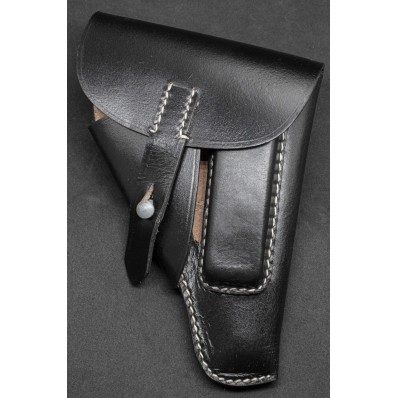


Black Leather Holster for Walther PPK
New
Black leather holster for the Walther PPK 7.65 mm, with full flap, light stitching, spare magazine pouch and leather strap with metal stud closure. A compact pattern for German pocket pistols, used by officers, police personnel and uniformed service members.
Warning: Last items in stock!
- Satisfied or refunded: we guarantee 100% secure protection on your purchases
- Free return: return your order free of charge within 30 days from receipt
- Secure payments: pay securely online with PayPal or credit cards

More info
Black leather holster for the Walther PPK in 7.65 mm, made in the typical form used for compact German semi-automatic pocket pistols. The Walther PPK, short for Polizeipistole Kriminalmodell, was the shorter and more concealable version of the Walther PP, originally developed for detective police, officials, officers and personnel requiring a smaller sidearm.
The holster is made from black leather and features a full protective flap, a front pouch for a spare magazine, visible stitching and a leather retaining strap with a metal stud closure. The reverse side normally carried a single belt loop, allowing the holster to be worn on a service belt. This compact arrangement protected the pistol, kept an additional magazine close at hand and avoided the bulk of larger military holsters made for weapons such as the P08 Luger or Walther P38. Described PPK holsters commonly include thick black leather, light stitching, a spare magazine pouch, a leather strap and a metal stud closure.
The 7.65 mm Browning / .32 ACP calibre was widely used in European pocket pistols of the period. Walther PP and PPK pistols appeared in civilian, police and military contexts, especially among officers, administrative personnel, police units and services that did not require a full-size service pistol. Collector references identify 7.65 mm pocket pistols as standard sidearms used by German police units, including the Ordnungspolizei, while wartime PPK holsters are also associated with officers and political or administrative personnel.
Historically, the PPK became successful because it combined compact dimensions, reliable mechanics and refined manufacturing. It was smaller than the Walther PP but retained the same general system: semi-automatic operation, exposed hammer, double-action trigger and single-stack magazine. Its reduced size shaped the holster as well: shorter, close-fitting and discreet, intended more for daily service wear than for heavy infantry field equipment.
A less obvious detail concerns markings. Not all PPK holsters carried prominent military acceptance stamps. Many came from civilian or police supply channels and may show only a maker mark, R.B.Nr. code, date stamp or no visible marking at all. For this reason, identification often depends on construction details: leather type, flap shape, stitching, magazine pouch, belt loop and closure strap position.
Suitable for Walther PPK 7.65 mm, compact German pocket pistols and historically consistent officer, police or service-personnel displays. The black leather, full flap and spare magazine pouch reflect the sober and functional appearance of German holsters designed for small-frame sidearms.
30 other products in the same category:

Customers who bought this product also bought:
Field and Personal Equipment
- Germany
- Uniforms
- Medals, Orders and Decorations
- Badges and Pins
- ID Tags
- Arm Shields
- Helmets
- Helmet Decals
- Visor Caps and Hats
- Cap and Helmet Badges
- Collar Tabs Badges
- Collar Tabs, Shoulder Boards and Epaulettes
- Arm Bands
- Division Cuff Titles
- Buckles And Belts
- Buttons For Uniforms
- Stamps
- Gorgets
- Rings
- SS Honour Ring in 925 Silver - Collector's Set
- Poletops
- Flags
- Daggers and Knives (Ornamental)
- Field Marshal Batons
- Field and Personal Equipment
- Service Watches
- Presentation Cases
- Documents and Award Letters
- Busts, Eagles, Lighters and Miscellaneous
- Croatian and Ustasha Militaria
- Denazified Articles
- Commemorative Necklaces
- Spare Parts, Small Parts and Accessories
- Italy
- Medals and Decorations
- Brevets And Badges
- Battle Shields and Tags
- Gorgets
- Visor Caps and Hats
- Cap and Helmet Badges
- Helmets Decals
- Friezes for Collar Tabs
- Collar Tabs, Shoulder Boards and Epaulettes
- Buckles
- Belts
- Buttons For Uniforms
- Rings
- Poletops
- Italian Resistance
- Keyrings
- Wallshields
- Daggers and Knives
- Flags
- Busts and Eagles
- Souvenirs
- Commemorative Necklaces
- Imperial Germany
- Soviet Union
- Other Countries