
No products
Product successfully added to your shopping cart
There are 0 items in your cart. There is 1 item in your cart.
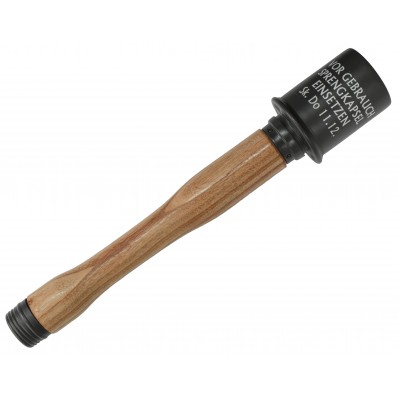


M24 Stielhandgranate – “Potato Masher” Grenade
New
German Stielhandgranate 24, commonly referred to as the M24 and nicknamed the “potato masher” because of its distinctive shape. Introduced in 1924 and used by the Reichswehr and Wehrmacht, it consisted of a cylindrical sheet-steel head, a hollow wooden handle and a delayed-action friction igniter.
Product temporarily out of stock.
- Satisfied or refunded: we guarantee 100% secure protection on your purchases
- Free return: return your order free of charge within 30 days from receipt
- Secure payments: pay securely online with PayPal or credit cards

More info
The Stielhandgranate 24 was Germany’s principal stick grenade from the mid-1920s until the later stages of the Second World War. The designation M24, widely used in modern reference works and collecting terminology, derives from its year of adoption; the contemporary German military name was Stielhandgranate 24. Its cylindrical head and long wooden handle produced the familiar Allied nickname “potato masher”, corresponding to the German term Kartoffelstampfer.
Adopted by the Reichswehr in 1924, the design was an improved development of the German stick grenades used during the First World War. Its relatively light construction and long handle provided convenient carrying and throwing characteristics. At the beginning of the Second World War it was the Wehrmacht’s standard hand grenade, before being supplemented by the compact Eihandgranate 39 and eventually replaced by the simplified Stielhandgranate 43.
The grenade measured approximately 35.6 centimetres in overall length and weighed about 480 grams. Its cylindrical head was manufactured from thin sheet steel, stood approximately 75 millimetres high and had a diameter of about 60 millimetres. The head contained roughly 165 grams of explosive, normally Füllpulver 02, a TNT-based filling. Alternative compositions, including Donarit, were also used according to manufacturer, production period and material availability.
Because the head was made from thin steel, it produced comparatively limited natural fragmentation. The Stielhandgranate 24 was therefore classified primarily as an offensive or concussion grenade, relying largely on blast pressure rather than a dense fragmentation pattern. Its effects were particularly suited to trenches, buildings, bunkers and other enclosed positions where pressure could be more significant than the breakup of the casing.
The turned wooden handle was hollow and housed the ignition components. These included the Brennzünder 24 friction igniter, a pull cord terminating in a porcelain ball and a threaded metal safety cap at the lower end. The standard igniter incorporated a delay of approximately four and a half seconds before initiating the Sprengkapsel Nr. 8 detonator.
For transport and storage safety, the detonators were normally packed separately. Early grenade heads consequently carried the white instruction “Vor Gebrauch Sprengkapsel einsetzen”, meaning “insert detonator before use.” This inscription was removed from production in April 1940 and is an important identifying feature of pre-war and early-war examples.
The metal head was normally painted in an ordnance green or grey-green colour. The wooden handle could retain its natural finish or receive a protective coating. Paint colour and finish varied between manufacturers and production periods. A limited number of late examples are also known with dark-yellow heads, reflecting some of the changing finishes encountered in German ordnance production during the final years of the war.
Markings could include the manufacturer’s name or coded identity, production year, lot number, Waffenamt acceptance stamps and inked information concerning the explosive filling. Maker and date markings were generally stamped into the top of the head and applied to the wooden handle. Full four-digit years were common until 1942, after which only the final two digits were normally used.
Several manufacturing simplifications appeared as the war progressed. Parts previously secured with screws were replaced by pressed or crimped fittings, the weatherproofing arrangements around the handle were altered and the lower safety cap was simplified. These changes reduced machining time and material consumption and provide visible distinctions between early, mid-war and late-production examples.
From 1942-1943 the grenade could be fitted with a removable Splitterring, or fragmentation sleeve, placed around the metal head. The sleeve increased the number of fragments produced by the detonation. Both smooth designs and versions divided into raised square sections were manufactured. A grenade fitted with this accessory was intended more for use from protected positions than the standard thin-cased configuration.
A reusable Übungs-Stielhandgranate 24 was produced for training. It retained a similar shape and weight but used a reinforced head with gas-venting holes and normally incorporated red-painted identification features. The visually similar Nebelhandgranate 39 was a smoke grenade distinguished by white markings and smoke outlets beneath the canister.
Stielhandgranaten 24 were transported in purpose-made crates containing fifteen grenades, with igniters and detonators packed separately. Production continued until approximately 1944, when the design was superseded by the Stielhandgranate 43, which used a solid handle, a simplified head attachment and an igniter mounted directly on top of the grenade body.
Data sheet
| Width | 6 cm |
| Lenght | 36 cm |
| Weight | 314.3 gr |
| Material | Wood, Metal |
| Disclaimer | Ornamental item devoid of any function, completely inert. A scenic item intended for museum mannequins. |
30 other products in the same category:

Customers who bought this product also bought:
Field and Personal Equipment
- Germany
- Uniforms
- Medals, Orders and Decorations
- Badges and Pins
- ID Tags
- Arm Shields
- Helmets
- Helmet Decals
- Visor Caps and Hats
- Cap and Helmet Badges
- Collar Tabs Badges
- Collar Tabs, Shoulder Boards and Epaulettes
- Arm Bands
- Division Cuff Titles
- Buckles And Belts
- Buttons For Uniforms
- Stamps
- Gorgets
- Rings
- SS Honour Ring in 925 Silver - Collector's Set
- Poletops
- Flags
- Daggers and Knives (Ornamental)
- Field Marshal Batons
- Field and Personal Equipment
- Service Watches
- Presentation Cases
- Documents and Award Letters
- Busts, Eagles, Lighters and Miscellaneous
- Croatian and Ustasha Militaria
- Denazified Articles
- Commemorative Necklaces
- Spare Parts, Small Parts and Accessories
- Italy
- Medals and Decorations
- Brevets And Badges
- Battle Shields and Tags
- Gorgets
- Visor Caps and Hats
- Cap and Helmet Badges
- Helmets Decals
- Friezes for Collar Tabs
- Collar Tabs, Shoulder Boards and Epaulettes
- Buckles
- Belts
- Buttons For Uniforms
- Rings
- Poletops
- Italian Resistance
- Keyrings
- Wallshields
- Daggers and Knives
- Flags
- Busts and Eagles
- Souvenirs
- Commemorative Necklaces
- Imperial Germany
- Soviet Union
- Other Countries