
No products
Product successfully added to your shopping cart
There are 0 items in your cart. There is 1 item in your cart.
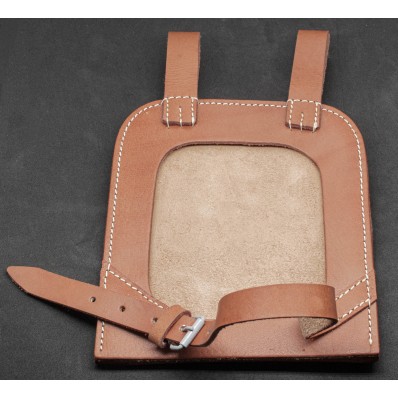


Straight Shovel Cover with Solid Back in Brown Leather
New
Brown leather cover for the German straight entrenching shovel, with solid back construction, belt loops and buckle strap. An early carrier pattern for the fixed field shovel, using a fuller leather body than later open-back versions made to reduce material use.
Warning: Last items in stock!
- Satisfied or refunded: we guarantee 100% secure protection on your purchases
- Free return: return your order free of charge within 30 days from receipt
- Secure payments: pay securely online with PayPal or credit cards

More info
Brown leather cover for the German straight entrenching shovel of the Second World War, made for carrying the traditional fixed field shovel rather than the folding Klappspaten. This carrier was designed to hold the metal blade while leaving the wooden handle downward, allowing the tool to be worn on the belt or field equipment.
The defining feature is the solid back construction. The shovel blade slid between two layers of leather, forming a pocket-like carrier that protected both the tool and the soldier’s uniform or equipment. Specialist field-equipment references describe this type as little changed from the First World War model, produced in several variations from leather or artificial leather known as Kunstleder, and secured by a strap and buckle.
Compared with later open-back carriers, the solid-back version used more leather. Later patterns were simplified to save material by removing the full rear panel, while the solid-back carrier retained the more complete early construction. Collector and retail descriptions identify the brown solid-back model as an early pattern for the straight shovel, preceding the more material-saving open-back carrier.
Brown leather was consistent with many German field-equipment components, especially earlier or less standardized supply batches. The carrier was purely functional: it covered the blade, stabilized the shovel during movement and allowed it to be combined with other belt equipment. A useful technical detail is that the securing strap could also help hold the end of the bayonet scabbard, reducing rattling and unwanted movement while marching.
The straight entrenching shovel remained one of the most common tools carried by German soldiers. It was used for digging foxholes, improving field positions, cutting small trenches, preparing shelters and general earthwork. Even after the introduction of the folding shovel, the fixed shovel continued in service because it was simple, durable and already available in large quantities.
A less obvious historical detail is the continuity of the design. The Second World War straight-shovel carrier was not a completely new piece of equipment, but a continuation of a proven First World War concept. The main wartime changes concerned material economy and production simplification rather than the basic shape of the carrier.
Suitable for German straight entrenching shovels, field-equipment displays and historically consistent infantry setups. Its brown leather, solid back, belt loops and buckle strap reflect the practical and durable character of early German shovel carriers.
30 other products in the same category:

Field and Personal Equipment
- Germany
- Uniforms
- Medals, Orders and Decorations
- Badges and Pins
- ID Tags
- Arm Shields
- Helmets
- Helmet Decals
- Visor Caps and Hats
- Cap and Helmet Badges
- Collar Tabs Badges
- Collar Tabs, Shoulder Boards and Epaulettes
- Arm Bands
- Division Cuff Titles
- Buckles And Belts
- Buttons For Uniforms
- Stamps
- Gorgets
- Rings
- SS Honour Ring in 925 Silver - Collector's Set
- Poletops
- Flags
- Daggers and Knives (Ornamental)
- Field Marshal Batons
- Field and Personal Equipment
- Service Watches
- Presentation Cases
- Documents and Award Letters
- Busts, Eagles, Lighters and Miscellaneous
- Croatian and Ustasha Militaria
- Denazified Articles
- Commemorative Necklaces
- Spare Parts, Small Parts and Accessories
- Italy
- Medals and Decorations
- Brevets And Badges
- Battle Shields and Tags
- Gorgets
- Visor Caps and Hats
- Cap and Helmet Badges
- Helmets Decals
- Friezes for Collar Tabs
- Collar Tabs, Shoulder Boards and Epaulettes
- Buckles
- Belts
- Buttons For Uniforms
- Rings
- Poletops
- Italian Resistance
- Keyrings
- Wallshields
- Daggers and Knives
- Flags
- Busts and Eagles
- Souvenirs
- Commemorative Necklaces
- Imperial Germany
- Soviet Union
- Other Countries