
No products
Product successfully added to your shopping cart
There are 0 items in your cart. There is 1 item in your cart.
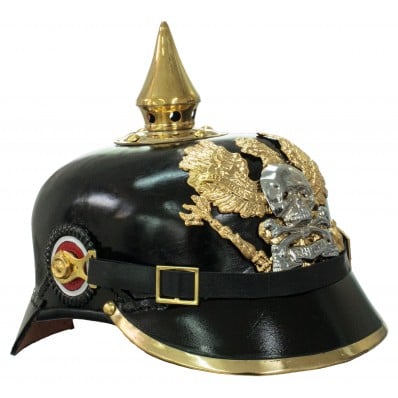


M1895 Pickelhaube of Brunswick Infantry Regiment No. 92 for Enlisted Ranks and NCOs
New
M1895 Pickelhaube for enlisted and NCO ranks of Brunswick Infantry Regiment No. 92. Its plate combined an eagle bearing the motto “Mit Gott für Fürst und Vaterland” with a silver-coloured Totenkopf and the “PENINSULA” honour scroll commemorating the regiment’s Napoleonic-era service.
Warning: Last items in stock!
- Satisfied or refunded: we guarantee 100% secure protection on your purchases
- Free return: return your order free of charge within 30 days from receipt
- Secure payments: pay securely online with PayPal or credit cards

More info
The M1895 Pickelhaube of Brunswick Infantry Regiment No. 92 was the characteristic helmet worn by the regiment’s enlisted and NCO ranks. The unit represented the principal infantry formation of the Duchy of Brunswick and was incorporated into the Prussian Army as part of the X Army Corps, while retaining its Brunswick title, state cockade and distinctive tradition badges.
The historical helmet was constructed from pressed and hardened leather with a glossy black lacquered finish. Its front and rear peaks were stitched to the skull and reinforced with metal edging. The infantry spike was mounted on a circular base secured by four studs. The rear spine could incorporate the adjustable ventilation shutter associated with the M1895 pattern.
Standard enlisted and NCO versions generally used brass or yellow-metal fittings. A black leather chinstrap, adjustable through two buckles, was attached to Model 1891 side posts. The ordinary liner consisted of multiple leather tongues joined by a drawstring and provided only limited adjustment beyond the helmet’s stated size.
The front plate was based on the Prussian eagle but modified for the Brunswick contingent. Its scroll carried the motto “Mit Gott für Fürst und Vaterland”, meaning “With God for Prince and Fatherland”, rather than the reference to the king found on the standard Prussian infantry eagle. This alteration expressed the regiment’s connection to the Duchy of Brunswick.
Applied to the eagle was the Brunswick Totenkopf, manufactured from nickel silver or another white-metal material. It depicted a frontal skull above two crossed bones. Beneath it appeared the “PENINSULA” honour scroll. The combination of a yellow-metal eagle and silver-coloured skull created a two-part plate closely associated with the regiment.
The Peninsula distinction commemorated the service of Brunswick formations during the Peninsular War against Napoleon. After Duke Frederick William raised his corps in 1809, part of the Brunswick infantry entered British service and fought in the Iberian Peninsula and southern France. These campaigns became an important component of the traditions inherited by Infantry Regiment No. 92.
The Totenkopf originated with the Black Brunswickers, or Schwarze Schar, raised by Duke Frederick William in 1809 to fight Napoleonic rule. Within the Brunswick tradition, the emblem was connected with the corps’ black uniforms, dynastic mourning and continued resistance. Its origin predates the later use of similar skull emblems by National Socialist organizations by more than a century.
The Totenkopf was initially restricted to the III Battalion, known as the Fusilier or Life Battalion. In 1889 the battalion received imperial authorization to retain the emblem. An order dated 27 January 1912 extended the right to the I and II Battalions and abolished the Brunswick star previously worn by those formations. Consequently, the entire regiment displayed the Totenkopf during the First World War.
The black, white and red Imperial cockade was positioned on the right side of the helmet, while the blue-and-yellow Brunswick state cockade was worn on the left. Together they represented the regiment’s affiliation with both the German Empire and the Duchy of Brunswick.
The ordinary enlisted and NCO helmet carried a leather chinstrap. Senior NCOs entitled to the sword knot could wear privately purchased examples with refined fittings, distinctive cockades and, in some configurations, metal chinscales. Officer helmets differed further through higher-grade skull construction, leather sweatbands, textile or silk linings and alternative spike-base fasteners.
For field service, the Pickelhaube could be covered with a cloth helmet cover to conceal the glossy black leather and reflective metal fittings. Simplified wartime versions later appeared with grey metal fittings and removable spikes. From 1916, the Pickelhaube was progressively replaced in front-line service by the Stahlhelm, which provided substantially better protection against fragments.
The helmets were manufactured in different head sizes. Interior markings could identify the maker, size, year, clothing depot or issuing regiment. The leather-tongued liner allowed minor adjustment to the wearer’s head shape but did not make the helmet one-size-fits-all.
Historical note: during the First World War, Brunswick Infantry Regiment No. 92 was the only infantry regiment in the Imperial German Army officially authorized to wear the Totenkopf on its headgear. The other Imperial units associated with the symbol were cavalry formations, including Brunswick Hussar Regiment No. 17 and two Prussian hussar regiments.
10 other products in the same category:

Customers who bought this product also bought:
Helmets
- Germany
- Uniforms
- Medals, Orders and Decorations
- Badges and Pins
- ID Tags
- Arm Shields
- Helmets
- Helmet Decals
- Visor Caps and Hats
- Cap and Helmet Badges
- Collar Tabs Badges
- Collar Tabs, Shoulder Boards and Epaulettes
- Arm Bands
- Division Cuff Titles
- Buckles And Belts
- Buttons For Uniforms
- Stamps
- Gorgets
- Rings
- SS Honour Ring in 925 Silver - Collector's Set
- Poletops
- Flags
- Daggers and Knives (Ornamental)
- Field Marshal Batons
- Field and Personal Equipment
- Service Watches
- Presentation Cases
- Documents and Award Letters
- Busts, Eagles, Lighters and Miscellaneous
- Croatian and Ustasha Militaria
- Denazified Articles
- Commemorative Necklaces
- Spare Parts, Small Parts and Accessories
- Italy
- Medals and Decorations
- Brevets And Badges
- Battle Shields and Tags
- Gorgets
- Visor Caps and Hats
- Cap and Helmet Badges
- Helmets Decals
- Friezes for Collar Tabs
- Collar Tabs, Shoulder Boards and Epaulettes
- Buckles
- Belts
- Buttons For Uniforms
- Rings
- Poletops
- Italian Resistance
- Keyrings
- Wallshields
- Daggers and Knives
- Flags
- Busts and Eagles
- Souvenirs
- Commemorative Necklaces
- Imperial Germany
- Soviet Union
- Other Countries