
No products
Product successfully added to your shopping cart
There are 0 items in your cart. There is 1 item in your cart.
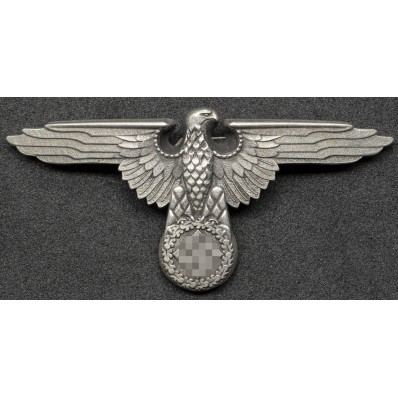


SS Eagle for Visor Cap - Ferdinand Wagner (Silver)
New
Silver-coloured metal eagle of the 1936 pattern for the SS visor cap, with outstretched wings and a swastika within a wreath. The reverse bears the RZM symbol and “475/39” marking, attributed to Ferdinand Wagner of Pforzheim and associated with 1939. The historical badge was attached by rear prongs.
- Satisfied or refunded: we guarantee 100% secure protection on your purchases
- Free return: return your order free of charge within 30 days from receipt
- Secure payments: pay securely online with PayPal or credit cards

More info
The SS Eagle for Visor Cap - Ferdinand Wagner (Silver) represents the metal cap insignia introduced in 1936 for SS peaked caps. This design replaced earlier forms derived from the eagles used by political organisations and remained in service throughout the following years and during the Second World War.
The badge depicts a stylised eagle with outstretched wings. Its head is turned to its heraldic right, corresponding to the viewer’s left. The wings extend in an almost horizontal line and display clearly divided groups of geometric feathers. The talons rest upon the upper part of a circular wreath enclosing a swastika.
Its compact body, nearly straight wings and regularly arranged plumage distinguish the design from earlier political eagles and from the emblems used by other German organisations. The simplified construction allowed the principal details to remain recognisable within the relatively limited dimensions of a metal cap badge.
On the SS visor cap, the eagle was positioned centrally on the front of the crown, immediately above the cap band. The SS Totenkopf, or skull badge, was attached separately to the band below it. The two metal insignia consequently formed a vertical arrangement, with the eagle in the upper position and the skull beneath it.
This eagle pattern was worn on the peaked caps of both the Allgemeine-SS and the armed SS formations later incorporated into the Waffen-SS. The eagle alone did not indicate a particular unit, service branch or rank. Differences in rank were principally shown through the chinstrap or cord, piping, cap construction and other elements of the uniform.
Historical badges were manufactured as rigid metal fittings with a raised design on the front. Documented constructions include non-ferrous metal, aluminium, Cupal and zinc, usually completed with silver plating or a silver-coloured surface wash. The term “Silver” therefore describes the visible colour and finish rather than necessarily identifying the underlying metal.
Attachment to the visor cap was generally provided by two prongs, split pins or metal tabs fitted to the reverse. These passed through the textile and internal reinforcement of the crown before being folded or secured on the inside. The two-point fastening prevented the badge from rotating and maintained the horizontal alignment of its wings.
The reverse bears the RZM symbol and the code “475/39.” The Reichszeugmeisterei der NSDAP regulated and supervised the manufacture of uniforms, insignia and equipment for National Socialist organisations. Its system included approved patterns, production requirements and identification markings for authorised manufacturers.
The 475/39 marking is associated with Ferdinand Wagner of Pforzheim, a German city with an established tradition of metalware, jewellery and insignia production. The /39 suffix belongs to the system of codes accompanied by a year and is generally interpreted as a reference to 1939. Ferdinand Wagner is also associated with the RZM code M1/8, encountered on other types and production series of metal insignia.
The rigid visor-cap eagle differs from woven or embroidered sleeve and field-cap eagles through its construction, proportions and rear fastening system. The RZM symbol, 475/39 marking, silver-coloured finish and distinctive configuration of the eagle are the principal identifying characteristics of the variant attributed to Ferdinand Wagner.
Data sheet
| Width | 32.65 mm |
| Lenght | 69.65 mm |
| Weight | 13 gr |
| Material | Zamak, Brass |
30 other products in the same category:

Customers who bought this product also bought:
Cap and Helmet Badges
- Germany
- Uniforms
- Medals, Orders and Decorations
- Badges and Pins
- ID Tags
- Arm Shields
- Helmets
- Helmet Decals
- Visor Caps and Hats
- Cap and Helmet Badges
- Collar Tabs Badges
- Collar Tabs, Shoulder Boards and Epaulettes
- Arm Bands
- Division Cuff Titles
- Buckles And Belts
- Buttons For Uniforms
- Stamps
- Gorgets
- Rings
- SS Honour Ring in 925 Silver - Collector's Set
- Poletops
- Flags
- Daggers and Knives (Ornamental)
- Field Marshal Batons
- Field and Personal Equipment
- Service Watches
- Presentation Cases
- Documents and Award Letters
- Busts, Eagles, Lighters and Miscellaneous
- Croatian and Ustasha Militaria
- Denazified Articles
- Commemorative Necklaces
- Spare Parts, Small Parts and Accessories
- Italy
- Medals and Decorations
- Brevets And Badges
- Battle Shields and Tags
- Gorgets
- Visor Caps and Hats
- Cap and Helmet Badges
- Helmets Decals
- Friezes for Collar Tabs
- Collar Tabs, Shoulder Boards and Epaulettes
- Buckles
- Belts
- Buttons For Uniforms
- Rings
- Poletops
- Italian Resistance
- Keyrings
- Wallshields
- Daggers and Knives
- Flags
- Busts and Eagles
- Souvenirs
- Commemorative Necklaces
- Imperial Germany
- Soviet Union
- Other Countries