
No products
Product successfully added to your shopping cart
There are 0 items in your cart. There is 1 item in your cart.
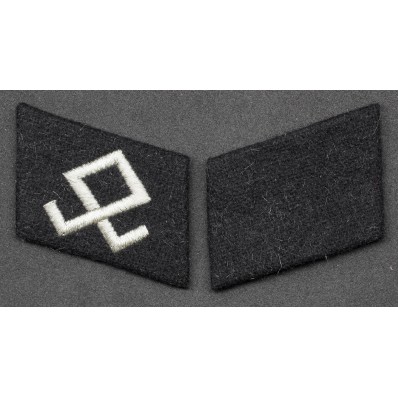


Prinz Eugen Collar Tabs of the 7. SS-Freiwilligen-Gebirgs-Division
New
Prinz Eugen collar tabs of the 7. SS-Freiwilligen-Gebirgs-Division, a Waffen-SS mountain formation raised in the Banat and active in the Balkans from 1942 to 1945. One tab bears the Odal rune, the divisional emblem; the other remains black, as on period sets.
- Satisfied or refunded: we guarantee 100% secure protection on your purchases
- Free return: return your order free of charge within 30 days from receipt
- Secure payments: pay securely online with PayPal or credit cards

More info
The collar tabs of the 7. SS-Freiwilligen-Gebirgs-Division “Prinz Eugen” represent one of the most distinctive divisional insignia patterns used within Waffen-SS uniform practice. Unlike the standard SS collar tabs bearing the double runes, this set was arranged asymmetrically: one black tab displayed the Odal rune, used as the divisional emblem, while the opposite tab remained plain black. This simple but highly recognizable configuration identified personnel of the “Prinz Eugen” division, a mountain formation created for operations in the Balkans during the Second World War. The unit was formed largely from Volksdeutsche, ethnic Germans from the Banat and other Danubian and southeastern European regions, including areas linked to Romania, Hungary and the former Yugoslavia. Its title referred to Prince Eugene of Savoy, a Habsburg military commander historically associated with the Danube frontier and campaigns against the Ottoman Empire.
Operationally, the division served from 1942 to 1945 and was employed mainly in occupied Yugoslavia and surrounding Balkan territories. Its role was centered on mountain warfare, security operations and anti-partisan campaigns in areas such as Serbia, Croatia, Bosnia, Montenegro and Dalmatia. Historical accounts also record the division’s involvement in serious war crimes during the occupation and counter-insurgency war, an essential part of the unit’s historical context. The division’s designation evolved during the war: after its earlier volunteer formation phase, the term “Gebirgs” was added in 1943, and in October of the same year it received the number 7, producing the full designation 7. SS-Freiwilligen-Gebirgs-Division “Prinz Eugen.”
The most important technical feature of the tabs is the Odal rune. In Germanic symbolic tradition, this sign was associated with inheritance, ancestry and ancestral land. Within the “Prinz Eugen” division, it functioned as a carefully chosen emblem for a unit recruited largely from ethnic German communities outside the Reich. A less commonly noted detail is that the insignia therefore reflected not only the division’s official identity, but also the ethnic and geographic logic behind its recruitment. For this reason, these collar tabs are studied not merely as uniform accessories, but as compact historical documents: a small pair of insignia that connects material culture, divisional organization, Balkan wartime history and the visual language of Waffen-SS formations.
30 other products in the same category:

Customers who bought this product also bought:
Collar Tabs, Shoulder Boards and Epaulettes
- Germany
- Uniforms
- Medals, Orders and Decorations
- Badges and Pins
- ID Tags
- Arm Shields
- Helmets
- Helmet Decals
- Visor Caps and Hats
- Cap and Helmet Badges
- Collar Tabs Badges
- Collar Tabs, Shoulder Boards and Epaulettes
- Arm Bands
- Division Cuff Titles
- Buckles And Belts
- Buttons For Uniforms
- Stamps
- Gorgets
- Rings
- SS Honour Ring in 925 Silver - Collector's Set
- Poletops
- Flags
- Daggers and Knives (Ornamental)
- Field Marshal Batons
- Field and Personal Equipment
- Service Watches
- Presentation Cases
- Documents and Award Letters
- Busts, Eagles, Lighters and Miscellaneous
- Croatian and Ustasha Militaria
- Denazified Articles
- Commemorative Necklaces
- Spare Parts, Small Parts and Accessories
- Italy
- Medals and Decorations
- Brevets And Badges
- Battle Shields and Tags
- Gorgets
- Visor Caps and Hats
- Cap and Helmet Badges
- Helmets Decals
- Friezes for Collar Tabs
- Collar Tabs, Shoulder Boards and Epaulettes
- Buckles
- Belts
- Buttons For Uniforms
- Rings
- Poletops
- Italian Resistance
- Keyrings
- Wallshields
- Daggers and Knives
- Flags
- Busts and Eagles
- Souvenirs
- Commemorative Necklaces
- Imperial Germany
- Soviet Union
- Other Countries