
No products
Product successfully added to your shopping cart
There are 0 items in your cart. There is 1 item in your cart.
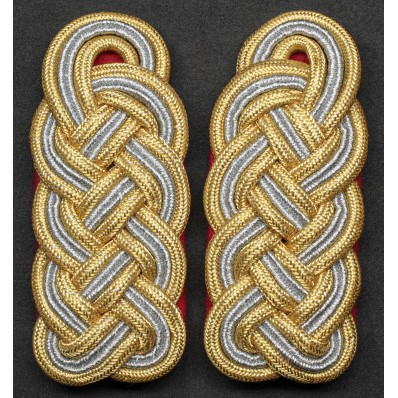


Shoulder Boards for Heer Generals
New
General des Heeres shoulder boards of the Wehrmacht, used by German Army generals during the Second World War. Braided gold and silver cords on a scarlet red underlay, with gilt buttons and silver rank stars according to grade, worn on Heer service and dress uniforms.
- Satisfied or refunded: we guarantee 100% secure protection on your purchases
- Free return: return your order free of charge within 30 days from receipt
- Secure payments: pay securely online with PayPal or credit cards

More info
General des Heeres shoulder boards of the Wehrmacht, the distinctive shoulder-rank insignia worn by general officers of the German Heer during the Second World War. In German uniform terminology, these are properly described as Schulterstücke, the braided shoulder boards of officers, rather than the simpler Schulterklappen associated with enlisted ranks and many NCO patterns.
The standard construction for Heer general officers consisted of a broad braided arrangement of gold and silver cords. Uniform references describe generals’ shoulder boards as being made with a silver central cord between gold bullion or Celleon cords, mounted on a scarlet red underlay. The buttons were gilt, while rank stars were normally silver.
The scarlet red underlay, known in German as Hochrot, was one of the defining features of Heer general officer insignia. Unlike ordinary Waffenfarbe branch colours used for many other ranks, Hochrot identified the wearer as part of the general officer corps. From 1944, generals in certain specialist services were instructed to replace scarlet with their specific branch colour, but this order was not always consistently followed in practice.
Rank was shown through silver metal stars placed on the braided board. The basic board identified the wearer as a general officer, while the number of stars distinguished grades such as Generalmajor, Generalleutnant, General der Infanterie, General der Artillerie, General der Panzertruppe, Generaloberst and equivalent branch generals. For Generalfeldmarschall, crossed marshal’s batons in silver metal replaced the normal rank stars.
A notable regulation change concerned the shoulder boards of the Generalfeldmarschall. On 3 April 1941, the central silver cord was ordered to be replaced by a gold one, creating an all-gold board for the highest military rank. This made the field marshal’s shoulder boards visually distinct from those of other general officers.
Historically, these shoulder boards belonged to the Wehrmacht’s rank system between 1935 and 1945. They appeared on service, dress and, depending on period and context, field garments or greatcoats. Their role was practical as well as visual: they immediately communicated senior command status within the military hierarchy.
A less obvious technical detail concerns wartime materials. High-quality examples used metallic bullion, while wartime production could also employ Celleon, a glossy artificial fibre used as a substitute for metal thread. Original examples also show variations in the size and finish of the silver rank stars, reflecting different makers, production periods and uniform applications.
Data sheet
| Lenght | 10.5 cm |
| Width | 4.5 cm |
30 other products in the same category:

Customers who bought this product also bought:
Collar Tabs, Shoulder Boards and Epaulettes
- Germany
- Uniforms
- Medals, Orders and Decorations
- Badges and Pins
- ID Tags
- Arm Shields
- Helmets
- Helmet Decals
- Visor Caps and Hats
- Cap and Helmet Badges
- Collar Tabs Badges
- Collar Tabs, Shoulder Boards and Epaulettes
- Arm Bands
- Division Cuff Titles
- Buckles And Belts
- Buttons For Uniforms
- Stamps
- Gorgets
- Rings
- SS Honour Ring in 925 Silver - Collector's Set
- Poletops
- Flags
- Daggers and Knives (Ornamental)
- Field Marshal Batons
- Field and Personal Equipment
- Service Watches
- Presentation Cases
- Documents and Award Letters
- Busts, Eagles, Lighters and Miscellaneous
- Croatian and Ustasha Militaria
- Denazified Articles
- Commemorative Necklaces
- Spare Parts, Small Parts and Accessories
- Italy
- Medals and Decorations
- Brevets And Badges
- Battle Shields and Tags
- Gorgets
- Visor Caps and Hats
- Cap and Helmet Badges
- Helmets Decals
- Friezes for Collar Tabs
- Collar Tabs, Shoulder Boards and Epaulettes
- Buckles
- Belts
- Buttons For Uniforms
- Rings
- Poletops
- Italian Resistance
- Keyrings
- Wallshields
- Daggers and Knives
- Flags
- Busts and Eagles
- Souvenirs
- Commemorative Necklaces
- Imperial Germany
- Soviet Union
- Other Countries