
No products
Product successfully added to your shopping cart
There are 0 items in your cart. There is 1 item in your cart.
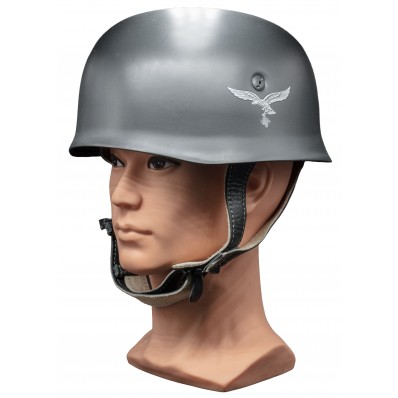


M38 Fallschirmjäger Helmet with Double Decal
New
M38 Fallschirmjäger Helmet with Double Decal, German WWII paratrooper helmet with low-profile shell, compact shape and jump-specific liner system. The two side decals, Luftwaffe eagle and national shield, reflect early pre-war and early-war helmet configurations.
Warning: Last items in stock!
- Satisfied or refunded: we guarantee 100% secure protection on your purchases
- Free return: return your order free of charge within 30 days from receipt
- Secure payments: pay securely online with PayPal or credit cards

More info
M38 Fallschirmjäger Helmet with Double Decal
The M38 Fallschirmjäger Helmet with Double Decal represents one of the most recognizable German helmet designs of the Second World War. Developed for the Fallschirmjäger, the paratrooper branch of the Luftwaffe, it differed sharply from standard German Stahlhelm models. Its shell was lower, more compact and lacked the pronounced front visor and extended rear skirt found on infantry helmets. This reduced profile was designed for airborne use, where a conventional helmet could interfere with parachute equipment or create dangerous leverage during landing.
The final M38 pattern was introduced in 1938, following the earlier and much rarer M36 and M37 paratrooper helmet models. The M38 became the standard helmet for German paratroopers and remained in use, with production variations, until the end of the war. Specialist references identify the M36, M37 and M38 as the main Fallschirmjäger helmet types, with the M38 becoming the regular wartime pattern.
The double decal configuration belongs mainly to early production and early-war examples. One side of the shell carried the Luftwaffe eagle, while the other displayed the national tricolor shield. Early M38 helmets were often finished in smooth feldgrau or green-grey paint with two decals. As wartime production evolved, the configuration was simplified: later helmets commonly carried a single Luftwaffe decal, while late-war examples were often issued without decals.
Technically, the M38 was defined by its specialized liner and chinstrap system. The leather liner and more secure retention arrangement were designed to keep the helmet stable during the jump, parachute opening and landing. The liner was fixed to the shell with distinctive bolts, commonly referred to as spanner bolts. Later production examples also used slotted bolts, vented or unvented, reflecting the gradual simplification of wartime manufacturing.
The M38 Fallschirmjäger helmet is closely associated with early German airborne operations, including the campaigns in the Low Countries and Crete. A notable technical detail lies in its silhouette: the shortened shell was not an aesthetic choice, but a functional solution. By removing the long rear skirt and projecting front brim of the standard Stahlhelm, the helmet reduced snagging risks and helped limit force transmitted to the neck during parachute deployment and landing.
Data sheet
| Material | Steel, Leather |
| DISCLAIMER | No PPE (personal protective equipment). This product can be only used for decoration purposes or costumes. |
7 other products in the same category:

Customers who bought this product also bought:
Helmets
- Germany
- Uniforms
- Medals, Orders and Decorations
- Badges and Pins
- ID Tags
- Arm Shields
- Helmets
- Helmet Decals
- Visor Caps and Hats
- Cap and Helmet Badges
- Collar Tabs Badges
- Collar Tabs, Shoulder Boards and Epaulettes
- Arm Bands
- Division Cuff Titles
- Buckles And Belts
- Buttons For Uniforms
- Stamps
- Gorgets
- Rings
- SS Honour Ring in 925 Silver - Collector's Set
- Poletops
- Flags
- Daggers and Knives (Ornamental)
- Field Marshal Batons
- Field and Personal Equipment
- Service Watches
- Presentation Cases
- Documents and Award Letters
- Busts, Eagles, Lighters and Miscellaneous
- Croatian and Ustasha Militaria
- Denazified Articles
- Commemorative Necklaces
- Spare Parts, Small Parts and Accessories
- Italy
- Medals and Decorations
- Brevets And Badges
- Battle Shields and Tags
- Gorgets
- Visor Caps and Hats
- Cap and Helmet Badges
- Helmets Decals
- Friezes for Collar Tabs
- Collar Tabs, Shoulder Boards and Epaulettes
- Buckles
- Belts
- Buttons For Uniforms
- Rings
- Poletops
- Italian Resistance
- Keyrings
- Wallshields
- Daggers and Knives
- Flags
- Busts and Eagles
- Souvenirs
- Commemorative Necklaces
- Imperial Germany
- Soviet Union
- Other Countries