
No products
Product successfully added to your shopping cart
There are 0 items in your cart. There is 1 item in your cart.
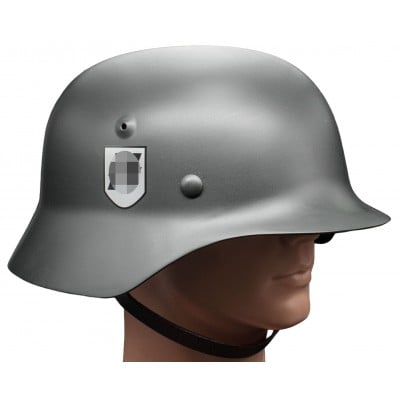


Waffen-SS Double Decal M35 Helmet
New
Waffen-SS Double Decal M35 Helmet, Model 1935 steel Stahlhelm with rolled rim and separate ventilation bushings. An early German helmet pattern used by SS-VT and Waffen-SS formations, identifiable by its two side decals applied under the first uniform regulations.
- Satisfied or refunded: we guarantee 100% secure protection on your purchases
- Free return: return your order free of charge within 30 days from receipt
- Secure payments: pay securely online with PayPal or credit cards

More info
Waffen-SS Double Decal M35 Helmet – Stahlhelm Model 1935
The Stahlhelm Model 1935, commonly known as the M35, was one of the most distinctive German helmet designs of the twentieth century. Officially introduced in 1935, it replaced earlier helmet types derived from the First World War, including the M16, M17 and M18. Compared with those earlier patterns, the M35 had a more compact shell, cleaner lines and a more refined manufacturing standard. Its shell was made from pressed steel, with a rolled rim folded inward around the lower edge and separate metal ventilation bushings inserted into the sides.
The term double decal refers to the early regulation layout in which two decals were applied to the helmet shell. One side usually carried the national shield, while the opposite side displayed the insignia of the service or organization. In the case of SS-VT and later Waffen-SS units, this arrangement belongs mainly to the early period of issue, before battlefield requirements, camouflage considerations and simplified wartime regulations led to the reduction or removal of helmet decals.
The M35 was normally fitted with a leather liner mounted on a metal liner band and secured with a leather chinstrap. Shell sizes varied, while the liner system allowed the helmet to be adjusted to the wearer. Early finishes were generally smoother and more carefully applied; as the war progressed, paint surfaces became increasingly matte, rough and utilitarian, reflecting changing production priorities.
Within Waffen-SS equipment history, the double decal M35 is connected with a relatively narrow period: the pre-war and early-war years, when armed SS formations were expanding from smaller politically controlled units into larger military structures. As later M40 and M42 helmets entered production, the M35 became less common in new issue, though many earlier helmets remained in service.
A notable technical detail is the M35’s use of separate ventilation bushings. These small inserted fittings gave the helmet a precise and well-finished appearance, but they also required extra manufacturing steps. On the later M40, the vents were stamped directly into the shell, reducing production time and cost. This small construction difference is one of the clearest ways to identify the M35 model today.
Data sheet
| Material | Steel, Leather |
| DISCLAIMER | No PPE (personal protective equipment). This product can be only used for decoration purposes or costumes. |
7 other products in the same category:

Customers who bought this product also bought:
Helmets
- Germany
- Uniforms
- Medals, Orders and Decorations
- Badges and Pins
- ID Tags
- Arm Shields
- Helmets
- Helmet Decals
- Visor Caps and Hats
- Cap and Helmet Badges
- Collar Tabs Badges
- Collar Tabs, Shoulder Boards and Epaulettes
- Arm Bands
- Division Cuff Titles
- Buckles And Belts
- Buttons For Uniforms
- Stamps
- Gorgets
- Rings
- SS Honour Ring in 925 Silver - Collector's Set
- Poletops
- Flags
- Daggers and Knives (Ornamental)
- Field Marshal Batons
- Field and Personal Equipment
- Service Watches
- Presentation Cases
- Documents and Award Letters
- Busts, Eagles, Lighters and Miscellaneous
- Croatian and Ustasha Militaria
- Denazified Articles
- Commemorative Necklaces
- Spare Parts, Small Parts and Accessories
- Italy
- Medals and Decorations
- Brevets And Badges
- Battle Shields and Tags
- Gorgets
- Visor Caps and Hats
- Cap and Helmet Badges
- Helmets Decals
- Friezes for Collar Tabs
- Collar Tabs, Shoulder Boards and Epaulettes
- Buckles
- Belts
- Buttons For Uniforms
- Rings
- Poletops
- Italian Resistance
- Keyrings
- Wallshields
- Daggers and Knives
- Flags
- Busts and Eagles
- Souvenirs
- Commemorative Necklaces
- Imperial Germany
- Soviet Union
- Other Countries