
No products
Product successfully added to your shopping cart
There are 0 items in your cart. There is 1 item in your cart.
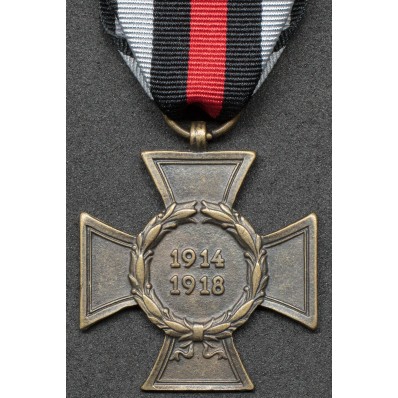


Honour Cross 1914/1918 Without Swords
New
The Honour Cross 1914/1918 Without Swords was the version awarded to First World War participants who were not classified as front-line combatants. It has the form of a cross pattée with the central dates 1914 / 1918, an oak-leaf wreath and a black, white and red ribbon.
- Satisfied or refunded: we guarantee 100% secure protection on your purchases
- Free return: return your order free of charge within 30 days from receipt
- Secure payments: pay securely online with PayPal or credit cards

More info
The Honour Cross 1914/1918 Without Swords, officially known in German as the Ehrenkreuz für Kriegsteilnehmer, was part of the Ehrenkreuz des Weltkrieges 1914/1918, instituted on 13 July 1934 by Reich President Paul von Hindenburg. The decoration was created as a commemorative award for service and participation in the First World War and became the official German service cross connected with the 1914–1918 conflict.
The version without swords must be distinguished from the Ehrenkreuz für Frontkämpfer, or Front-Line Combatants’ Cross, which carried two crossed swords between the arms of the cross. The absence of swords identified the award as the version for Kriegsteilnehmer, meaning war participants who were not classified as front-line combatants. This distinction separated the three principal forms of the decoration: the cross with swords for front-line veterans, the cross without swords for non-front-line participants, and the black version without swords for widows and parents of fallen participants.
The decoration is shaped as a cross pattée, with broad arms and a circular central medallion. The centre bears the dates 1914 and 1918, arranged one above the other. Around the medallion is a wreath of oak leaves, a defining feature of the version without swords. The oak-leaf wreath, the absence of swords and the bronze-coloured finish are the main visual elements used to identify this variant.
The cross is commonly described as bronze, although many wartime and interwar mass-produced examples were made from iron or steel with a bronze-coloured finish. This was due to the very large production numbers and material considerations during manufacture. The reverse is usually plain and may carry a maker’s mark, initials or coded manufacturer stamp. These marks are commonly found on the reverse of the cross or near the suspension loop.
The medal was worn suspended from a ribbon attached through a loop at the upper arm of the cross. The ribbon used for the combatant and non-combatant versions followed the German imperial colours black, white and red. The next-of-kin version, issued to widows and parents of fallen participants, used a related but differently arranged ribbon and a black-finished cross.
Each award was normally accompanied by a certificate, known as an Urkunde, stating the category of the cross awarded. The documents differed according to whether the award was for a front-line combatant, a war participant, a widow or a parent. The award was issued in very large numbers, with millions of examples distributed across the different classes.
A notable feature of the Honour Cross without swords is the wide range of manufacturing variations. Because the award was produced by many firms, surviving examples show differences in the shape of the cross arms, the modelling of the oak leaves, the sharpness of the central dates, the colour and durability of the bronze finish, and the style of the maker’s mark. Some examples have crisp, sharply struck detail, while others display softer reliefs or worn bronze finish exposing the base metal beneath.
Data sheet
| Lenght | 39.58 mm |
| Width | 35.66 mm |
| Thickness | 1.50 mm |
| Weight | 9 gr |
| Material | Zamak |
30 other products in the same category:

Customers who bought this product also bought:
Medals With Ribbon
- Germany
- Uniforms
- Medals, Orders and Decorations
- Badges and Pins
- ID Tags
- Arm Shields
- Helmets
- Helmet Decals
- Visor Caps and Hats
- Cap and Helmet Badges
- Collar Tabs Badges
- Collar Tabs, Shoulder Boards and Epaulettes
- Arm Bands
- Division Cuff Titles
- Buckles And Belts
- Buttons For Uniforms
- Stamps
- Gorgets
- Rings
- SS Honour Ring in 925 Silver - Collector's Set
- Poletops
- Flags
- Daggers and Knives (Ornamental)
- Field Marshal Batons
- Field and Personal Equipment
- Service Watches
- Presentation Cases
- Documents and Award Letters
- Busts, Eagles, Lighters and Miscellaneous
- Croatian and Ustasha Militaria
- Denazified Articles
- Commemorative Necklaces
- Spare Parts, Small Parts and Accessories
- Italy
- Medals and Decorations
- Brevets And Badges
- Battle Shields and Tags
- Gorgets
- Visor Caps and Hats
- Cap and Helmet Badges
- Helmets Decals
- Friezes for Collar Tabs
- Collar Tabs, Shoulder Boards and Epaulettes
- Buckles
- Belts
- Buttons For Uniforms
- Rings
- Poletops
- Italian Resistance
- Keyrings
- Wallshields
- Daggers and Knives
- Flags
- Busts and Eagles
- Souvenirs
- Commemorative Necklaces
- Imperial Germany
- Soviet Union
- Other Countries