
No products
Product successfully added to your shopping cart
There are 0 items in your cart. There is 1 item in your cart.
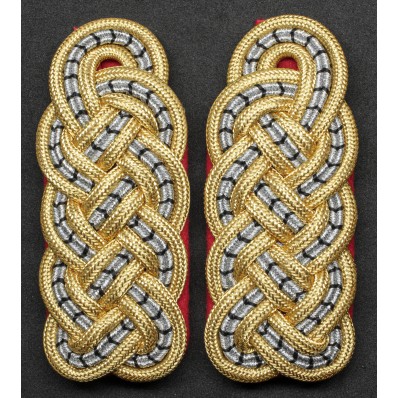


Shoulder Boards for Generals of the Imperial German Army
New
M-07/10 slip-on Schulterklappen for Imperial German Army generals, worn on dress and service tunics. Made with two gold strands interwoven with the Prussian colour cord on a red cloth backing, this pattern was used by general officers from Generalmajor to Generalfeldmarschall during the Great War.
- Satisfied or refunded: we guarantee 100% secure protection on your purchases
- Free return: return your order free of charge within 30 days from receipt
- Secure payments: pay securely online with PayPal or credit cards

More info
M-07/10 slip-on Schulterklappen for general officers of the Imperial German Army, a distinctive shoulder-rank insignia associated with the uniform system of the First World War. The German term Schulterklappen refers to shoulder straps or shoulder boards worn on the tunic, while the designation M-07/10 connects this type with the uniform developments introduced around 1907 and updated in 1910.
This pair follows the slip-on pattern, meaning that the boards were designed to be fitted to the tunic without permanent stitching. Specialist uniform references describe M07/10 slip-on shoulder straps as having a rear tongue that allowed them to be attached to, and removed from, the garment.
The construction reflects the distinctive appearance of Imperial German general officer insignia: two gold strands interwoven with the Prussian colour cord, mounted on a red cloth backing. The red underlay created a strong visual contrast with the gold braid and formed part of the recognizable appearance of general officers’ shoulder insignia. This style was worn by army general officers from Generalmajor through Generalfeldmarschall, and could be used on both dress and service tunics.
Within the Imperial German Army, shoulder boards were not merely decorative details. They communicated rank, military status and branch tradition at a glance. For general officers, the gold interwoven construction identified the general officer category, while the precise rank was normally indicated by the addition of rank stars. This explains why the same basic shoulder-board form could be used across several senior grades.
The M-07/10 slip-on system also reflects the broader evolution of German military dress before and during the First World War. Uniform components increasingly had to balance formal appearance with practical service use, and removable shoulder boards allowed a tunic to be fitted, maintained or adapted more easily.
A technical point of interest is the rear tongue of the slip-on construction. On many surviving original examples, the exposed upper face shows more wear than the hidden tongue beneath the shoulder loop, because the latter was protected by the tunic itself. This small construction detail is one of the features that helps distinguish removable service-pattern Schulterklappen from permanently sewn or more ceremonial shoulder insignia.
Data sheet
| Lenght | 10.5 cm |
| Width | 4.5 cm |
2 other products in the same category:

Customers who bought this product also bought:
Collar Tabs, Shoulder Boards and Epaulettes
- Germany
- Uniforms
- Medals, Orders and Decorations
- Badges and Pins
- ID Tags
- Arm Shields
- Helmets
- Helmet Decals
- Visor Caps and Hats
- Cap and Helmet Badges
- Collar Tabs Badges
- Collar Tabs, Shoulder Boards and Epaulettes
- Arm Bands
- Division Cuff Titles
- Buckles And Belts
- Buttons For Uniforms
- Stamps
- Gorgets
- Rings
- SS Honour Ring in 925 Silver - Collector's Set
- Poletops
- Flags
- Daggers and Knives (Ornamental)
- Field Marshal Batons
- Field and Personal Equipment
- Service Watches
- Presentation Cases
- Documents and Award Letters
- Busts, Eagles, Lighters and Miscellaneous
- Croatian and Ustasha Militaria
- Denazified Articles
- Commemorative Necklaces
- Spare Parts, Small Parts and Accessories
- Italy
- Medals and Decorations
- Brevets And Badges
- Battle Shields and Tags
- Gorgets
- Visor Caps and Hats
- Cap and Helmet Badges
- Helmets Decals
- Friezes for Collar Tabs
- Collar Tabs, Shoulder Boards and Epaulettes
- Buckles
- Belts
- Buttons For Uniforms
- Rings
- Poletops
- Italian Resistance
- Keyrings
- Wallshields
- Daggers and Knives
- Flags
- Busts and Eagles
- Souvenirs
- Commemorative Necklaces
- Imperial Germany
- Soviet Union
- Other Countries