
No products
Product successfully added to your shopping cart
There are 0 items in your cart. There is 1 item in your cart.
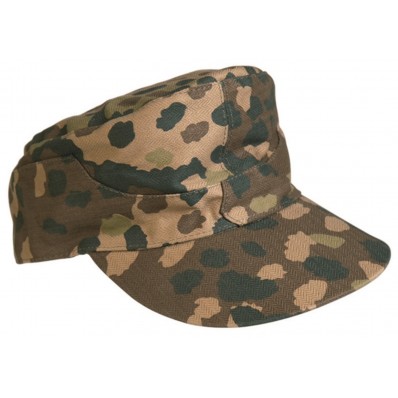

M44 Erbsenmuster Field Cap
New
M44-style field cap in Erbsenmuster, combining the compact late-war field-cap cut with the distinctive five-colour Waffen-SS Pea Dot camouflage. Although a familiar collector configuration today, unlike the matching M44 tunic and trousers, camouflage caps of this type are not clearly documented as a standard mass-produced issue item.
- Satisfied or refunded: we guarantee 100% secure protection on your purchases
- Free return: return your order free of charge within 30 days from receipt
- Secure payments: pay securely online with PayPal or credit cards

More info
The M44 Erbsenmuster Field Cap combines the compact form of the late-war German field cap with one of the most recognizable camouflage patterns associated with the Waffen-SS: Erbsenmuster 44, also widely known as Erbsentarn, Dot 44, Pea Dot or Pea Pattern.
Its general construction follows the development of German field caps of the 1943-1944 period, ultimately derived from the Einheitsfeldmütze M43.
The design featured a relatively low crown and short visor, creating a practical form of headwear suitable for everyday field use.
Unlike more structured service caps, the soft field cap was easy to wear with combat clothing and could be folded or stored relatively easily when not required.
Its defining visual feature is the Erbsenmuster camouflage pattern.
Introduced in 1944, Erbsenmuster used a complex combination of lighter background tones, greens, browns and very dark areas distributed through hundreds of small dots and irregular patches.
The familiar English term “Pea Dot” derives from these numerous rounded elements, many of which resemble small peas.
The pattern differed fundamentally from earlier camouflage designs based on broad geometric or organic shapes.
Instead, Erbsenmuster fragmented the entire visible surface through large numbers of overlapping small colour elements.
Viewed at close range, the pattern appears extremely complex. At increasing distance, however, the individual spots begin to merge visually into broader irregular areas of colour, helping disrupt recognition of the wearer's outline.
Another important feature was its intended multi-season character.
Earlier Waffen-SS camouflage smocks were commonly reversible, with greener spring and summer colours on one side and browner autumn tones on the other.
Erbsenmuster instead incorporated green, brown, light and dark colours together on a single printed surface, reducing the need for a reversible garment.
From 1944, the camouflage was used principally for a complete two-piece field uniform consisting of a tunic and trousers.
The historical position of an Erbsenmuster field cap, however, is considerably less straightforward.
Unlike the matching field tunic and trousers, there is no equally clear evidence for large-scale standardized production and issue of factory-made Pea Dot field caps as part of the official camouflage uniform.
This does not necessarily mean that camouflage caps of this type could never have appeared in wartime service.
German soldiers frequently used field-tailored, privately altered and locally manufactured garments, particularly during the increasingly chaotic final stages of the war.
Camouflage fabric remaining from damaged uniforms, tailoring alterations or production offcuts could potentially be reused for smaller items.
A field cap required only a relatively limited amount of material compared with a complete tunic or pair of trousers, making the use of Erbsenmuster fabric scraps particularly practical.
Any wartime examples should therefore be interpreted carefully. Such a cap could represent a field-made or tailor-made item rather than a standardized piece of factory-issued camouflage headwear.
The underlying field-cap form was itself part of the development that produced the M43 Einheitsfeldmütze, intended to simplify German field headwear and provide a practical general-purpose cap.
Its short visor protected the eyes from sunlight, while the relatively soft construction made the cap convenient during everyday field duties.
By the final stages of the war, German uniform production was increasingly affected by material shortages, decentralized manufacture and improvised use of available supplies.
Clothing was repaired and altered repeatedly, damaged garments were used as sources of material and small items could be manufactured from otherwise unusable scraps.
As a result, late-war photographs and surviving garments can occasionally show combinations that were never formally established as standardized uniform patterns.
The M44 Erbsenmuster Field Cap therefore combines the familiar late-war field-cap silhouette with the distinctive Pea Dot camouflage associated with the Waffen-SS during 1944-45.
Historical curiosity: while the Erbsenmuster tunic and trousers were genuinely manufactured as a coordinated camouflage field uniform, the matching Pea Dot field cap is far more historically elusive. Any wartime examples may have been locally tailored from leftover camouflage cloth rather than produced as part of the standard uniform issue. It is a fascinating reminder that the reality of late-war field clothing could differ considerably from official regulations and standardized uniform catalogues.
Data sheet
| Material | Upper: 100% Cotton Lining: 100% Cotton |
30 other products in the same category:

Customers who bought this product also bought:
Visor Caps and Hats
- Germany
- Uniforms
- Medals, Orders and Decorations
- Badges and Pins
- ID Tags
- Arm Shields
- Helmets
- Helmet Decals
- Visor Caps and Hats
- Cap and Helmet Badges
- Collar Tabs Badges
- Collar Tabs, Shoulder Boards and Epaulettes
- Arm Bands
- Division Cuff Titles
- Buckles And Belts
- Buttons For Uniforms
- Stamps
- Gorgets
- Rings
- SS Honour Ring in 925 Silver - Collector's Set
- Poletops
- Flags
- Daggers and Knives (Ornamental)
- Field Marshal Batons
- Field and Personal Equipment
- Service Watches
- Presentation Cases
- Documents and Award Letters
- Busts, Eagles, Lighters and Miscellaneous
- Croatian and Ustasha Militaria
- Denazified Articles
- Commemorative Necklaces
- Spare Parts, Small Parts and Accessories
- Italy
- Medals and Decorations
- Brevets And Badges
- Battle Shields and Tags
- Gorgets
- Visor Caps and Hats
- Cap and Helmet Badges
- Helmets Decals
- Friezes for Collar Tabs
- Collar Tabs, Shoulder Boards and Epaulettes
- Buckles
- Belts
- Buttons For Uniforms
- Rings
- Poletops
- Italian Resistance
- Keyrings
- Wallshields
- Daggers and Knives
- Flags
- Busts and Eagles
- Souvenirs
- Commemorative Necklaces
- Imperial Germany
- Soviet Union
- Other Countries