
No products
Product successfully added to your shopping cart
There are 0 items in your cart. There is 1 item in your cart.
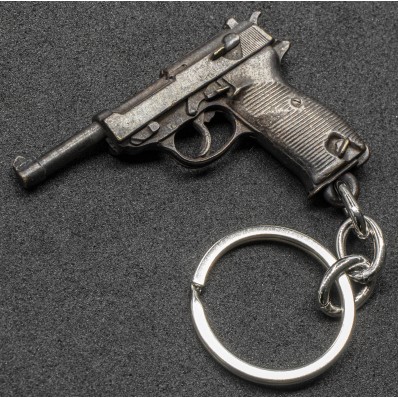


Walther P38 Keychain
New
Walther P38 Keychain
Metal keychain dedicated to the Walther P38, the semi-automatic pistol adopted by the Wehrmacht in 1938. Known for its 9×19 mm Parabellum chambering and advanced double-action/single-action system, it recalls one of the most distinctive German firearm profiles of the 20th century.
- Satisfied or refunded: we guarantee 100% secure protection on your purchases
- Free return: return your order free of charge within 30 days from receipt
- Secure payments: pay securely online with PayPal or credit cards

More info
Walther P38 Keychain
The Walther P38 was developed in the late 1930s from Walther’s AP – Armee Pistole and HP – Heeres Pistole projects. It was designed as a modern military sidearm intended to replace the older Luger P08 with a pistol better suited to industrial production, service reliability and contemporary tactical requirements. Its official adoption came in 1938, giving the weapon its designation, while wider military issue followed during the early years of the Second World War.
Technically, the P38 was one of the most influential service pistols of its generation. Chambered for 9×19 mm Parabellum, it used a locked-breech system with a falling locking block and combined it with a double-action/single-action trigger mechanism. This allowed the pistol to be carried with a chambered round and the hammer safely lowered, with the first shot fired in double action and subsequent shots in single action. The same functional concept later appeared in many post-war military and police pistols.
Wartime production was carried out mainly by Walther, Mauser and Spreewerk. To conceal manufacturing origins, factory letter codes were used: ac for Walther, byf for Mauser and cyq for Spreewerk. These markings are now essential for identifying and dating original examples, making the P38 one of the most closely studied German service pistols of the period.
The pistol’s visual identity remained unmistakable: an exposed barrel, open-top slide, angular frame and distinctive grip profile. After 1945, the design continued in post-war production, especially through the P1, adopted by the West German Bundeswehr and generally fitted with an aluminium alloy frame rather than the wartime steel frame.
A lesser-known collector detail concerns late Spreewerk production. Some pistols appear with the code “cvq” instead of “cyq”, not because of a new manufacturer, but because the original marking die became damaged. This small industrial accident created a recognizable variant that is still noted by collectors and researchers today.
This Walther P38 Keychain reproduces the silhouette of one of the most recognizable European military pistols of the 20th century, turning a historically significant technical profile into a compact accessory for collectors, enthusiasts and students of military material culture.
Data sheet
| Width | 35 mm |
| Lenght | 50 mm |
| Depth | 6.40 mm |
| Weight | 23.8 gr |
| Material | Zamak, Steel |
27 other products in the same category:

Customers who bought this product also bought:
Keyrings
- Germany
- Uniforms
- Medals, Orders and Decorations
- Badges and Pins
- ID Tags
- Arm Shields
- Helmets
- Helmet Decals
- Visor Caps and Hats
- Cap and Helmet Badges
- Collar Tabs Badges
- Collar Tabs, Shoulder Boards and Epaulettes
- Arm Bands
- Division Cuff Titles
- Buckles And Belts
- Buttons For Uniforms
- Stamps
- Gorgets
- Rings
- SS Honour Ring in 925 Silver - Collector's Set
- Poletops
- Flags
- Daggers and Knives (Ornamental)
- Field Marshal Batons
- Field and Personal Equipment
- Service Watches
- Presentation Cases
- Documents and Award Letters
- Busts, Eagles, Lighters and Miscellaneous
- Croatian and Ustasha Militaria
- Denazified Articles
- Commemorative Necklaces
- Spare Parts, Small Parts and Accessories
- Italy
- Medals and Decorations
- Brevets And Badges
- Battle Shields and Tags
- Gorgets
- Visor Caps and Hats
- Cap and Helmet Badges
- Helmets Decals
- Friezes for Collar Tabs
- Collar Tabs, Shoulder Boards and Epaulettes
- Buckles
- Belts
- Buttons For Uniforms
- Rings
- Poletops
- Italian Resistance
- Keyrings
- Wallshields
- Daggers and Knives
- Flags
- Busts and Eagles
- Souvenirs
- Commemorative Necklaces
- Imperial Germany
- Soviet Union
- Other Countries