
No products
Product successfully added to your shopping cart
There are 0 items in your cart. There is 1 item in your cart.
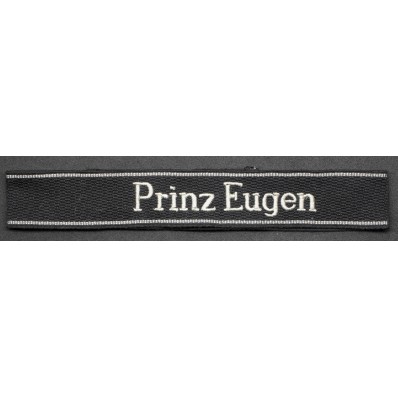


“Prinz Eugen” Cuff Title
New
“Prinz Eugen” cuff title, a black cloth sleeve band with grey-silver embroidered lettering. Worn by personnel of the 7th SS Volunteer Mountain Division “Prinz Eugen”, it identified a Waffen-SS mountain formation recruited largely from ethnic Germans in the Balkans.
- Satisfied or refunded: we guarantee 100% secure protection on your purchases
- Free return: return your order free of charge within 30 days from receipt
- Secure payments: pay securely online with PayPal or credit cards

More info
“Prinz Eugen” Cuff Title
The “Prinz Eugen” cuff title was a cloth uniform insignia associated with the 7th SS Volunteer Mountain Division “Prinz Eugen”, a Waffen-SS mountain division formed in 1942. Its name referred to Prince Eugene of Savoy, the Habsburg commander of the late seventeenth and early eighteenth centuries, remembered especially for campaigns against the Ottoman Empire in southeastern Europe.
In its enlisted and NCO form, the cuff title is generally described as a black cotton or rayon band with the central inscription “Prinz Eugen” machine-embroidered or machine-woven in grey-silver thread. Documented RZM-pattern examples show silver-aluminium borders along the upper and lower edges, often described as seven-strand wire tresses. Recorded dimensions for original examples are approximately 25-27 mm wide and around 47-48 cm long.
The division was formed largely from Volksdeutsche, ethnic Germans from southeastern Europe, including the Banat, Vojvodina, Croatia and Transylvania. The official German designation, 7. SS-Freiwilligen-Gebirgs-Division “Prinz Eugen”, reflected both its mountain-warfare role and its recruitment base outside the core territory of Germany.
The unit served mainly in the Balkans, where it was used extensively in anti-partisan operations against Yugoslav resistance forces. After the Italian armistice of 8 September 1943, elements of the division took part in disarming Italian forces in Dalmatia and occupying Adriatic towns and islands, including Split, Brač, Hvar, Korčula and the Pelješac peninsula.
The history of the division is also inseparable from war crimes, reprisals and violence against civilians and prisoners. Its anti-partisan operations in Yugoslavia were marked by massacres, village destructions and severe abuses against civilian populations. These facts are essential to any historically accurate description of the formation.
A specific historical detail concerns the choice of the name “Prinz Eugen” itself. Rather than drawing on a Prussian or strictly German military tradition, it evoked the Habsburg and Danubian world. For a division recruited heavily among German-speaking communities of southeastern Europe, the name carried a regional historical meaning connected to the frontier history of the Balkans and the old Austro-Hungarian sphere.
30 other products in the same category:

Customers who bought this product also bought:
Division Cuff Titles
- Germany
- Uniforms
- Medals, Orders and Decorations
- Badges and Pins
- ID Tags
- Arm Shields
- Helmets
- Helmet Decals
- Visor Caps and Hats
- Cap and Helmet Badges
- Collar Tabs Badges
- Collar Tabs, Shoulder Boards and Epaulettes
- Arm Bands
- Division Cuff Titles
- Buckles And Belts
- Buttons For Uniforms
- Stamps
- Gorgets
- Rings
- SS Honour Ring in 925 Silver - Collector's Set
- Poletops
- Flags
- Daggers and Knives (Ornamental)
- Field Marshal Batons
- Field and Personal Equipment
- Service Watches
- Presentation Cases
- Documents and Award Letters
- Busts, Eagles, Lighters and Miscellaneous
- Croatian and Ustasha Militaria
- Denazified Articles
- Commemorative Necklaces
- Spare Parts, Small Parts and Accessories
- Italy
- Medals and Decorations
- Brevets And Badges
- Battle Shields and Tags
- Gorgets
- Visor Caps and Hats
- Cap and Helmet Badges
- Helmets Decals
- Friezes for Collar Tabs
- Collar Tabs, Shoulder Boards and Epaulettes
- Buckles
- Belts
- Buttons For Uniforms
- Rings
- Poletops
- Italian Resistance
- Keyrings
- Wallshields
- Daggers and Knives
- Flags
- Busts and Eagles
- Souvenirs
- Commemorative Necklaces
- Imperial Germany
- Soviet Union
- Other Countries