
No products
Product successfully added to your shopping cart
There are 0 items in your cart. There is 1 item in your cart.
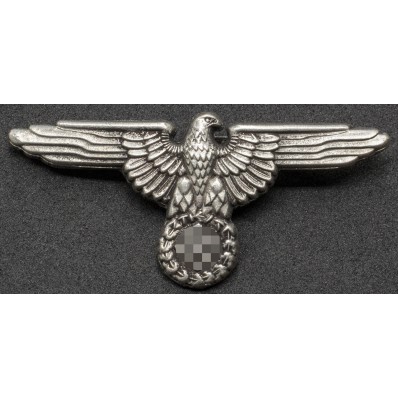


SS Eagle for Schirmmütze - Deschler & Sohn, München
New
Metal SS Eagle for Schirmmütze, marked on the reverse RZM M1/52, the maker code associated with Deschler & Sohn, Munich. The badge shows the eagle with outstretched wings above a wreath and central swastika, intended for mounting on the front of the visor cap.
- Satisfied or refunded: we guarantee 100% secure protection on your purchases
- Free return: return your order free of charge within 30 days from receipt
- Secure payments: pay securely online with PayPal or credit cards

More info
The SS Eagle for Schirmmütze was the metal national emblem worn on the front of the SS visor cap. In the standard arrangement, the eagle was positioned above the Totenkopf, while the skull badge was mounted lower on the front band of the cap. This combination of eagle and skull formed the characteristic metal insignia set of the SS Schirmmütze.
The version marked RZM M1/52 is associated with the firm Deschler & Sohn of Munich. The RZM marking system identified authorized manufacturers and controlled categories of uniform insignia and equipment. In the code M1/52, M1referred to the category of metal insignia, while 52 was the manufacturer number assigned to Deschler & Sohn. The marking is found on the reverse of the badge, often below or between the rear attachment prongs.
The design is the SS visor cap eagle type, with horizontally spread wings, a compact central body, a sideways-facing head and the talons resting on a wreath containing the swastika. The wings are long and relatively flat in outline, giving the badge a profile suited to the front of the Schirmmütze. The badge was usually made with a slight curve so that it could sit against the rounded surface of the cap.
Known M1/52 examples are documented in both Cupal and aluminium. Cupal was a composite material combining aluminium with a copper or copper-alloy layer, usually with a silver-coloured surface finish. On worn examples, the silver finish can be rubbed away on raised areas or on the reverse, exposing coppery or brownish tones beneath. Aluminium examples are lighter and generally show a more uniform silver-coloured surface.
Attachment to the cap was made by means of two rear prongs, also called Splinte in German. These prongs could be soldered directly to the back of the badge or attached to small backing plates that increased the soldering area and strengthened the mounting. On surviving loose examples, one or both prongs are often missing, bent or repaired, as they were thin elements exposed to stress when the badge was mounted or removed from the cap.
The eagle was used on SS Schirmmützen, including early black visor caps and later grey-green or field-grey cap types associated with changes in SS uniforms. Metal eagles were primarily connected with visor caps, while embroidered or woven eagles appeared on other forms of headgear or uniform garments. The exact form depended on the cap type, period, production method, manufacturer and available materials.
A specific point of interest in the Deschler M1/52 production is the range of small manufacturing variations. These may include the position of the RZM mark, the form of the rear prongs, the presence or absence of backing plates, the material used, the curvature of the badge, the sharpness of the feather detail, the modelling of the wreath and the depth of the strike. M1/52 eagles are often studied together with M1/52 Totenkopf badges, as both pieces formed the front insignia set of the SS visor cap.
Data sheet
| Width | 32 mm |
| Lenght | 69.60 mm |
| Thickness | 1.20 mm |
| Weight | 8.6 gr |
| Material | Zamak, Brass |
30 other products in the same category:

Customers who bought this product also bought:
Cap and Helmet Badges
- Germany
- Uniforms
- Medals, Orders and Decorations
- Badges and Pins
- ID Tags
- Arm Shields
- Helmets
- Helmet Decals
- Visor Caps and Hats
- Cap and Helmet Badges
- Collar Tabs Badges
- Collar Tabs, Shoulder Boards and Epaulettes
- Arm Bands
- Division Cuff Titles
- Buckles And Belts
- Buttons For Uniforms
- Stamps
- Gorgets
- Rings
- SS Honour Ring in 925 Silver - Collector's Set
- Poletops
- Flags
- Daggers and Knives (Ornamental)
- Field Marshal Batons
- Field and Personal Equipment
- Service Watches
- Presentation Cases
- Documents and Award Letters
- Busts, Eagles, Lighters and Miscellaneous
- Croatian and Ustasha Militaria
- Denazified Articles
- Commemorative Necklaces
- Spare Parts, Small Parts and Accessories
- Italy
- Medals and Decorations
- Brevets And Badges
- Battle Shields and Tags
- Gorgets
- Visor Caps and Hats
- Cap and Helmet Badges
- Helmets Decals
- Friezes for Collar Tabs
- Collar Tabs, Shoulder Boards and Epaulettes
- Buckles
- Belts
- Buttons For Uniforms
- Rings
- Poletops
- Italian Resistance
- Keyrings
- Wallshields
- Daggers and Knives
- Flags
- Busts and Eagles
- Souvenirs
- Commemorative Necklaces
- Imperial Germany
- Soviet Union
- Other Countries