
No products
Product successfully added to your shopping cart
There are 0 items in your cart. There is 1 item in your cart.
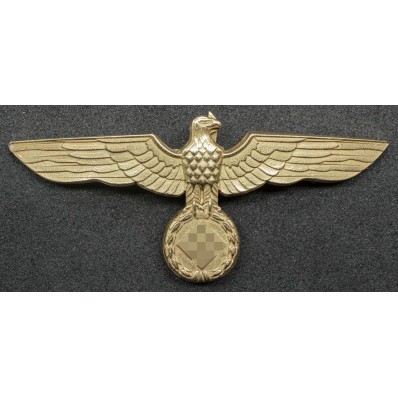


Kriegsmarine and Heer Generals Schirmmütze Eagle - G.H.O. 37
New
Kriegsmarine and Heer Generals Schirmmütze Eagle (Gold), reverse-marked G.H.O. 37 and commonly attributed to G. H. Osang, Dresden. A gold cap eagle for Kriegsmarine Schirmmützen and Heer general-rank configurations, with early construction and rear attachment prongs.
- Satisfied or refunded: we guarantee 100% secure protection on your purchases
- Free return: return your order free of charge within 30 days from receipt
- Secure payments: pay securely online with PayPal or credit cards

More info
Kriegsmarine and Heer Generals Schirmmütze Eagle (Gold)
This eagle represents a gold Schirmmütze cap eagle marked on the reverse G.H.O. 37. The initials are commonly attributed to G. H. Osang, Dresden, a German maker associated with metal insignia and awards. The number 37 refers to 1937, placing this pattern in the pre-war production period, before the more evident material substitutions and manufacturing simplifications of later wartime years.
The gold finish is the defining feature of this version. Unlike the standard silver Heer cap eagle, gold-finished examples are associated with the Kriegsmarine and with Heer general-rank cap configurations. In the Kriegsmarine, gold insignia formed part of the naval visual tradition, while for Heer generals the gold finish reflected the distinctive insignia style of senior rank.
On the Schirmmütze, the eagle was worn on the upper front of the cap, above the national cockade and oak-leaf wreath. On Kriegsmarine caps, the gold eagle created a strong contrast against dark blue or white cap bodies; on Heer generals’ caps, it formed part of a more elevated insignia arrangement associated with high command dress. This is why the same general eagle form can carry a different historical meaning depending on finish, cap type and branch context.
From a technical perspective, the G.H.O. 37 marking points to an early production type, generally connected with stamped metal or aluminium construction with a gold finish. The reverse was fitted with prongs or tabs, passed through the cap cloth and folded inside to secure the emblem. This was the standard practical attachment method for metal Schirmmütze eagles.
A useful detail is that identification should not rely on shape alone. The key features are finish, material, maker mark, attachment system and intended cap type. A silver example usually indicates standard Heer use, while a gold example is relevant to Kriegsmarine use or Heer generals’ cap insignia. The 1937 date also gives the piece a precise chronological value, linking it to an early and generally better-finished pre-war production phase.
Data sheet
| Lenght | 66.70 mm |
| Width | 28.60 mm |
| Thickness | 1 mm |
| Weight | 7,9 gr |
| Material | Zamak, Brass |
30 other products in the same category:

Customers who bought this product also bought:
Cap and Helmet Badges
- Germany
- Uniforms
- Medals, Orders and Decorations
- Badges and Pins
- ID Tags
- Arm Shields
- Helmets
- Helmet Decals
- Visor Caps and Hats
- Cap and Helmet Badges
- Collar Tabs Badges
- Collar Tabs, Shoulder Boards and Epaulettes
- Arm Bands
- Division Cuff Titles
- Buckles And Belts
- Buttons For Uniforms
- Stamps
- Gorgets
- Rings
- SS Honour Ring in 925 Silver - Collector's Set
- Poletops
- Flags
- Daggers and Knives (Ornamental)
- Field Marshal Batons
- Field and Personal Equipment
- Service Watches
- Presentation Cases
- Documents and Award Letters
- Busts, Eagles, Lighters and Miscellaneous
- Croatian and Ustasha Militaria
- Denazified Articles
- Commemorative Necklaces
- Spare Parts, Small Parts and Accessories
- Italy
- Medals and Decorations
- Brevets And Badges
- Battle Shields and Tags
- Gorgets
- Visor Caps and Hats
- Cap and Helmet Badges
- Helmets Decals
- Friezes for Collar Tabs
- Collar Tabs, Shoulder Boards and Epaulettes
- Buckles
- Belts
- Buttons For Uniforms
- Rings
- Poletops
- Italian Resistance
- Keyrings
- Wallshields
- Daggers and Knives
- Flags
- Busts and Eagles
- Souvenirs
- Commemorative Necklaces
- Imperial Germany
- Soviet Union
- Other Countries