
No products
Product successfully added to your shopping cart
There are 0 items in your cart. There is 1 item in your cart.
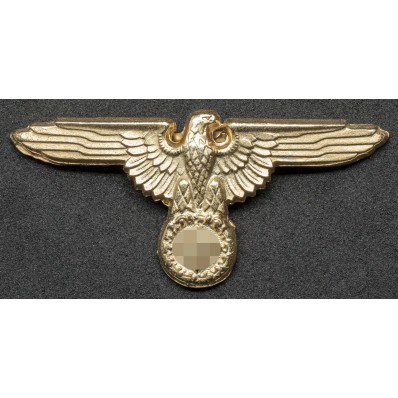


SS Eagle for Schirmmütze - SS 373/43 RZM (Gold)
New
Metal SS Eagle for Schirmmütze with gilt finish, marked on the reverse SS 373/43 RZM. The badge shows the eagle with outstretched wings above a wreath and central swastika, intended for mounting on the front of the visor cap.
- Satisfied or refunded: we guarantee 100% secure protection on your purchases
- Free return: return your order free of charge within 30 days from receipt
- Secure payments: pay securely online with PayPal or credit cards

More info
The Gilt SS Eagle for Schirmmütze follows the metal cap eagle pattern worn on the front of the SS visor cap. In the usual arrangement, the eagle was mounted on the upper front of the cap, while the Totenkopf was positioned below it on the central band. Together, these two metal devices formed the standard front insignia set of the SS Schirmmütze.
The badge depicts the eagle with horizontally spread wings, a compact central body, a sideways-facing head and the talons resting on a wreath containing the swastika. The wings are elongated and relatively flat in outline, with the feather detail rendered in linear relief. The badge is slightly curved so that it can follow the rounded surface of the visor cap. This curvature is a functional feature of cap eagles, as they were designed to sit against a shaped textile surface rather than a flat backing.
The reverse marking SS 373/43 RZM belongs to the type of markings found on certain wartime SS metal insignia. RZMrefers to the Reichszeugmeisterei, the body responsible for regulating and marking controlled uniform items and insignia. In this form of marking, 43 indicates the year 1943, while 373 is the associated maker or production code. This differs from RZM markings such as M1/52, where the category and maker number are expressed in a different format.
The gilt finish changes the appearance of the badge compared with the more common silver-coloured SS cap eagles made from aluminium, Cupal or silvered metal. The gold colour would have been a surface finish, applied as a thin wash, plating or similar treatment over the base metal. Wear normally appears first on the highest points of the relief, including the wing edges, head, breast, wreath and swastika. In these areas the underlying metal may become visible, showing different tones depending on the material beneath the finish.
Metal cap eagles could be made from several base materials, including aluminium, Cupal, zinc or other stamped alloys. Cupal can reveal coppery or brownish tones where the surface has worn, as it is composed of bonded metal layers. Zinc pieces may lose their surface coating and develop a dull grey appearance over time. On a gilt version, the gold colour should therefore be understood as a finish rather than the natural colour of the metal itself.
Attachment to the cap was by means of flat rear prongs or tabs. These were inserted through the cap material and folded over on the inside. Depending on the production method, the prongs could be soldered, crimped or fixed to small rear mounting areas. On loose surviving examples, bent, broken or replaced prongs are common, as the thin metal could weaken when opened and closed during removal from the cap.
The eagle was used on SS Schirmmützen, including black Allgemeine SS visor caps and later grey-green or field-grey cap types connected with the development of Waffen-SS uniforms. Metal eagles were chiefly associated with visor caps, while woven or embroidered insignia were more common on field caps, side caps and other forms of headgear. The specific type of insignia depended on cap form, period, regulation, production method and material availability.
A technical point of this SS 373/43 RZM version is the need to distinguish the marking on the eagle from similar markings found on Totenkopf badges. In some documented cap insignia sets, the skull is marked RZM SS 373/43, while the associated eagle bears a different marking, such as SS 475/43 RZM. Other references record eagles marked directly SS 373/43 RZM. For this reason, the exact location of the reverse mark, the form of the stamp, the construction of the prongs and the attribution of the marking to the eagle itself are central details of this specific variant.
30 other products in the same category:

Customers who bought this product also bought:
Cap and Helmet Badges
- Germany
- Uniforms
- Medals, Orders and Decorations
- Badges and Pins
- ID Tags
- Arm Shields
- Helmets
- Helmet Decals
- Visor Caps and Hats
- Cap and Helmet Badges
- Collar Tabs Badges
- Collar Tabs, Shoulder Boards and Epaulettes
- Arm Bands
- Division Cuff Titles
- Buckles And Belts
- Buttons For Uniforms
- Stamps
- Gorgets
- Rings
- SS Honour Ring in 925 Silver - Collector's Set
- Poletops
- Flags
- Daggers and Knives (Ornamental)
- Field Marshal Batons
- Field and Personal Equipment
- Service Watches
- Presentation Cases
- Documents and Award Letters
- Busts, Eagles, Lighters and Miscellaneous
- Croatian and Ustasha Militaria
- Denazified Articles
- Commemorative Necklaces
- Spare Parts, Small Parts and Accessories
- Italy
- Medals and Decorations
- Brevets And Badges
- Battle Shields and Tags
- Gorgets
- Visor Caps and Hats
- Cap and Helmet Badges
- Helmets Decals
- Friezes for Collar Tabs
- Collar Tabs, Shoulder Boards and Epaulettes
- Buckles
- Belts
- Buttons For Uniforms
- Rings
- Poletops
- Italian Resistance
- Keyrings
- Wallshields
- Daggers and Knives
- Flags
- Busts and Eagles
- Souvenirs
- Commemorative Necklaces
- Imperial Germany
- Soviet Union
- Other Countries