
No products
Product successfully added to your shopping cart
There are 0 items in your cart. There is 1 item in your cart.
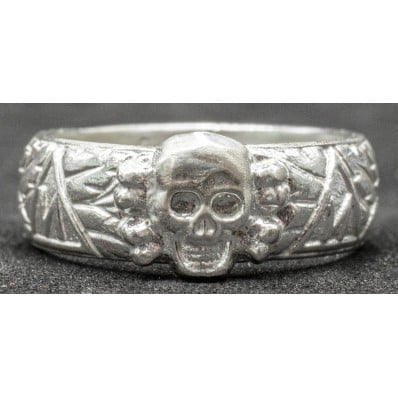


925 silver - Reinhard Heydrich Totenkopfring
New
Reinhard Heydrich Totenkopfring featuring the characteristic skull and crossbones, runic panels and oak-leaf ornamentation. The interior bears the personalized inscription “S.lb. Heydrich 21.6.39 H. Himmler”, recording the award date of 21 June 1939 and identifying its association with Reinhard Heydrich.
Warning: Last items in stock!
- Satisfied or refunded: we guarantee 100% secure protection on your purchases
- Free return: return your order free of charge within 30 days from receipt
- Secure payments: pay securely online with PayPal or credit cards

More info
The Reinhard Heydrich Totenkopfring belongs to the distinctive type known as the SS-Totenkopfring, also commonly referred to as the SS Honour Ring.
It was not a German state decoration and was not an award that could simply be purchased. The ring was bestowed under the authority of Reichsführer-SS Heinrich Himmler upon selected members of the SS.
The first Totenkopfrings appeared in 1933, initially within a relatively restricted circle. Eligibility was subsequently expanded, and manufacture and presentation continued until October 1944.
The example associated with Reinhard Heydrich carries the personalized interior inscription:
“S.lb. Heydrich 21.6.39 H. Himmler”
The abbreviation “S.lb.” represented “Seinem lieben”, followed by the recipient's surname. The inscription then records the presentation date of 21 June 1939 and a facsimile of Himmler's signature.
This internal personalization was one of the defining characteristics of the Totenkopfring. Each ring was therefore directly linked to an individual recipient and a specific date rather than being an anonymous mass-issued decoration.
The front is dominated by the characteristic Totenkopf with crossed bones, while the remainder of the band is covered with a complex combination of runic panels and oak-leaf ornamentation.
The skull itself had a military history predating National Socialism, having appeared in earlier German and Prussian formations. Within the SS, however, it became incorporated into a new ideological system of symbolism.
The design of the Totenkopfring is traditionally associated with Karl Maria Wiligut, a member of Himmler's circle who exercised considerable influence over the pseudo-Germanic and esoteric symbolism adopted within sections of the SS.
Production was undertaken by the Gahr firm in Munich. The skull was manufactured separately and attached to the decorated band, while the recipient's identifying inscription was applied to the interior.
The combination of skull, oak leaves and runic symbols was intended to give the ring a meaning beyond that of ordinary jewellery. Within the ideological framework of the SS, it represented membership, loyalty and the ritualized identity Himmler attempted to construct around the organization.
Regulations also placed unusual restrictions on ownership of the ring. In the event of the recipient's death or departure from the SS, the Totenkopfring was to be returned.
From 1938, rings returned following the deaths of their holders were collected at Wewelsburg Castle, which Himmler had developed as a symbolic and ceremonial centre for the SS.
Reinhard Heydrich was one of the most powerful figures within the Nazi security apparatus. After joining the SS in 1931, he became head of the Sicherheitsdienst – SD and rapidly emerged as one of Himmler's principal subordinates.
He later headed the Reich Security Main Office – RSHA, which brought together major components of the Nazi security and police system, including the Gestapo, criminal police and SD.
Heydrich was a major perpetrator and organizer of Nazi persecution and mass murder and chaired the Wannsee Conference in January 1942.
In 1941 he was appointed Deputy Reich Protector of Bohemia and Moravia, where his administration was marked by severe repression. He was critically wounded in Prague during Operation Anthropoid on 27 May 1942 and died on 4 June 1942.
The date engraved inside the ring, 21 June 1939, therefore belongs to a crucial period in Heydrich's rise within the SS hierarchy, only a few months before the formal creation of the RSHA.
Historical curiosity: the Totenkopfring was not intended to remain permanently with the recipient's family. SS regulations required the ring to be returned after its holder's death, and rings belonging to deceased recipients were eventually collected at Wewelsburg Castle. Thousands were reportedly returned during the period. The ultimate fate of much of this collection remains uncertain, adding another unusual chapter to the history of these individually engraved rings.
Data sheet
| Material | 925 Silver |
30 other products in the same category:

Customers who bought this product also bought:
Rings
- Germany
- Uniforms
- Medals, Orders and Decorations
- Badges and Pins
- ID Tags
- Arm Shields
- Helmets
- Helmet Decals
- Visor Caps and Hats
- Cap and Helmet Badges
- Collar Tabs Badges
- Collar Tabs, Shoulder Boards and Epaulettes
- Arm Bands
- Division Cuff Titles
- Buckles And Belts
- Buttons For Uniforms
- Stamps
- Gorgets
- Rings
- SS Honour Ring in 925 Silver - Collector's Set
- Poletops
- Flags
- Daggers and Knives (Ornamental)
- Field Marshal Batons
- Field and Personal Equipment
- Service Watches
- Presentation Cases
- Documents and Award Letters
- Busts, Eagles, Lighters and Miscellaneous
- Croatian and Ustasha Militaria
- Denazified Articles
- Commemorative Necklaces
- Spare Parts, Small Parts and Accessories
- Italy
- Medals and Decorations
- Brevets And Badges
- Battle Shields and Tags
- Gorgets
- Visor Caps and Hats
- Cap and Helmet Badges
- Helmets Decals
- Friezes for Collar Tabs
- Collar Tabs, Shoulder Boards and Epaulettes
- Buckles
- Belts
- Buttons For Uniforms
- Rings
- Poletops
- Italian Resistance
- Keyrings
- Wallshields
- Daggers and Knives
- Flags
- Busts and Eagles
- Souvenirs
- Commemorative Necklaces
- Imperial Germany
- Soviet Union
- Other Countries