
No products
Product successfully added to your shopping cart
There are 0 items in your cart. There is 1 item in your cart.
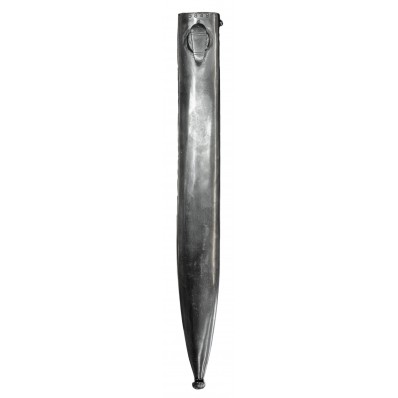


K98 Bayonet Scabbard – E. u. F. Hörster 1939
New
K98 Bayonet Scabbard – E. u. F. Hörster 1939, metal scabbard for the Seitengewehr 84/98 III used with the Karabiner 98k rifle. Marked by the Solingen maker E. & F. Hörster, it reflects early-war production before later coded manufacturer markings became widespread.
- Satisfied or refunded: we guarantee 100% secure protection on your purchases
- Free return: return your order free of charge within 30 days from receipt
- Secure payments: pay securely online with PayPal or credit cards

More info
K98 Bayonet Scabbard – E. u. F. Hörster 1939
The K98 Bayonet Scabbard – E. u. F. Hörster 1939 represents the metal scabbard used with the German Seitengewehr 84/98 III, commonly known among collectors as the K98 or K98k bayonet. This bayonet was intended for the Karabiner 98k, the standard German service rifle adopted in 1935. Compared with earlier long bayonets associated with the Gewehr 98, the 84/98 III was shorter and more compact, matching the reduced length and field role of the Karabiner 98k.
The marking E. u. F. Hörster 1939 identifies the well-known maker E. & F. Hörster of Solingen, one of Germany’s major blade-making centers. Hörster is documented as a manufacturer of 84/98 III bayonets, and surviving 1939 examples are recorded with E.u.F. Hörster markings and date indications on the blade or scabbard depending on the piece.
The scabbard’s function was to protect the blade and allow the bayonet to be carried safely on the belt. Made of metal, it followed the narrow profile of the blade and was fitted with a side stud for attachment to the leather frog. This allowed the bayonet to be worn at the soldier’s side, separate from the rifle but ready for use when required.
The year 1939 places the piece in the early phase of the Second World War. At this stage, many bayonets and scabbards still carried clear maker names or abbreviations. Later wartime production increasingly used letter or number manufacturer codes, making early named markings such as E. u. F. Hörster especially useful for historical and technical identification.
A notable collecting detail concerns matching serial numbers. On original sets, the bayonet and scabbard could share the same serial number, but many surviving combinations are now mismatched because of wartime replacement, depot handling, battlefield capture and post-war recombination. For this reason, collector descriptions often specify whether a bayonet and scabbard are matching or non-matching, a small detail that can significantly affect classification.
Data sheet
| Lenght | 27 cm |
| Width | 3,2 cm |
| Weight | 170 gr |
| Material | Steel |
30 other products in the same category:

Customers who bought this product also bought:
Spare Parts, Small Parts and Accessories
- Germany
- Uniforms
- Medals, Orders and Decorations
- Badges and Pins
- ID Tags
- Arm Shields
- Helmets
- Helmet Decals
- Visor Caps and Hats
- Cap and Helmet Badges
- Collar Tabs Badges
- Collar Tabs, Shoulder Boards and Epaulettes
- Arm Bands
- Division Cuff Titles
- Buckles And Belts
- Buttons For Uniforms
- Stamps
- Gorgets
- Rings
- SS Honour Ring in 925 Silver - Collector's Set
- Poletops
- Flags
- Daggers and Knives (Ornamental)
- Field Marshal Batons
- Field and Personal Equipment
- Service Watches
- Presentation Cases
- Documents and Award Letters
- Busts, Eagles, Lighters and Miscellaneous
- Croatian and Ustasha Militaria
- Denazified Articles
- Commemorative Necklaces
- Spare Parts, Small Parts and Accessories
- Italy
- Medals and Decorations
- Brevets And Badges
- Battle Shields and Tags
- Gorgets
- Visor Caps and Hats
- Cap and Helmet Badges
- Helmets Decals
- Friezes for Collar Tabs
- Collar Tabs, Shoulder Boards and Epaulettes
- Buckles
- Belts
- Buttons For Uniforms
- Rings
- Poletops
- Italian Resistance
- Keyrings
- Wallshields
- Daggers and Knives
- Flags
- Busts and Eagles
- Souvenirs
- Commemorative Necklaces
- Imperial Germany
- Soviet Union
- Other Countries