
No products
Product successfully added to your shopping cart
There are 0 items in your cart. There is 1 item in your cart.
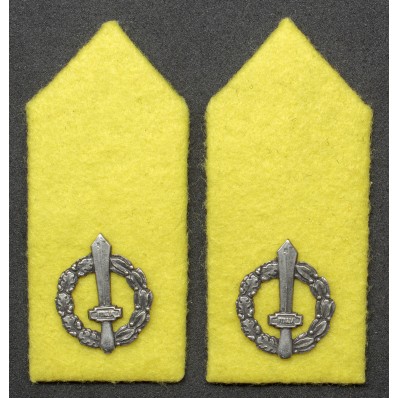


Second-Pattern M40 Collar Tabs for AR.CO. Units – National Republican Air Force
New
Pair of second-pattern M40 collar tabs for AR.CO. units of the National Republican Air Force. Yellow, pentagonal and smaller than the standard pattern, they bear the Republican gladius with “ITALIA” on the crossguard, oak on the viewer’s left and laurel on the right. Pattern used in 1944–1945.
- Satisfied or refunded: we guarantee 100% secure protection on your purchases
- Free return: return your order free of charge within 30 days from receipt
- Secure payments: pay securely online with PayPal or credit cards

More info
The Second-Pattern M40 Collar Tabs for AR.CO. Units of the National Republican Air Force belong to the insignia system worn by the anti-aircraft artillery of the Italian Social Republic during 1944–1945. They were displayed as a pair on the forward sections of the tunic collar and identified personnel serving in the anti-aircraft formations administered by the ANR.
This pattern is distinguished by its pentagonal shape and entirely yellow field, the branch colour assigned to AR.CO. The tabs are noticeably smaller than the usual standard collar patches and have proportions suited to the collar of the blue-grey M40 tunic associated with the National Republican Air Force.
The centre of each tab bears an upright Republican gladius, with the point of the blade facing upwards. The word “ITALIA” appears across the crossguard. This device was introduced by the armed forces of the Italian Social Republic as a replacement for the traditional five-pointed star formerly worn on Italian military collars.
The gladius is not surrounded exclusively by laurel leaves. When viewed from the front, the viewer’s left side carries an oak branch, identifiable by its lobed leaves and acorns. The viewer’s right side carries a laurel branch, formed from narrower, elongated leaves. The plant motif is therefore composite and asymmetrical.
Within military imagery, oak represented strength, steadfastness and endurance, while laurel was associated with victory, honour and military recognition. The Roman gladius formed the central symbol of combat and military authority, while the inscription “ITALIA” emphasised its national character.
The term second pattern identifies the standardised yellow pentagonal design that replaced the earlier rectangular blue collar tabs. The earlier forms could carry a red lightning bolt for aircraft observation and reporting personnel or a red cannon for members of the anti-aircraft batteries, in addition to the Republican gladius. These separate branch devices were omitted from the second pattern.
The description “bearing only the Republican gladius” consequently refers to the absence of the red lightning bolt or cannon. It does not mean that the device consisted solely of the sword or that its surrounding foliage was entirely laurel. The gladius retained its characteristic combination of oak and laurel.
The Artiglieria Contraerea, abbreviated AR.CO., was established within the National Republican Air Force on 1 January 1944. It absorbed personnel and structures from the previous territorial anti-aircraft organisation and included operational groups, batteries, depots, recruitment centres and a training school. The yellow collar tabs identified the AR.CO. branch rather than a particular rank or individual unit.
The prescribed uniform was the blue-grey pattern of the ANR. Wartime supply conditions nevertheless resulted in the simultaneous use of blue-grey Air Force garments, grey-green tunics inherited from the Royal Italian Army, khaki clothing and occasional German uniform items. The yellow second-pattern collar tab therefore became one of the principal visible means of identifying AR.CO. personnel.
Recorded variations may differ in the size and outline of the yellow backing, the proportions of the gladius, the form of the hilt and crossguard, the lettering of “ITALIA,” the number of leaves and the rendering of the acorns and laurel fruits. These differences reflect production by several wartime suppliers and the increasingly irregular availability of materials during the final months of the conflict.
Data sheet
| Lenght | 76 mm |
| Width | 33.50 mm |
| Weight | 7.1 gr |
| Material | Felt, Cotton, Cardboard, Zamak, Brass |
30 other products in the same category:

Collar Tabs, Shoulder Boards and Epaulettes
- Germany
- Uniforms
- Medals, Orders and Decorations
- Badges and Pins
- ID Tags
- Arm Shields
- Helmets
- Helmet Decals
- Visor Caps and Hats
- Cap and Helmet Badges
- Collar Tabs Badges
- Collar Tabs, Shoulder Boards and Epaulettes
- Arm Bands
- Division Cuff Titles
- Buckles And Belts
- Buttons For Uniforms
- Stamps
- Gorgets
- Rings
- SS Honour Ring in 925 Silver - Collector's Set
- Poletops
- Flags
- Firearms (Inert Replicas)
- Daggers and Knives (Ornamental)
- Field Marshal Batons
- Field and Personal Equipment
- Service Watches
- Presentation Cases
- Documents and Award Letters
- Busts, Eagles, Lighters and Miscellaneous
- Croatian and Ustasha Militaria
- Denazified Articles
- Commemorative Necklaces
- Spare Parts, Small Parts and Accessories
- Italy
- Medals and Decorations
- Brevets And Badges
- Battle Shields and Tags
- Gorgets
- Visor Caps and Hats
- Cap and Helmet Badges
- Helmets Decals
- Friezes for Collar Tabs
- Collar Tabs, Shoulder Boards and Epaulettes
- Buckles
- Belts
- Buttons For Uniforms
- Rings
- Poletops
- Italian Resistance
- Keyrings
- Wallshields
- Daggers and Knives
- Flags
- Busts and Eagles
- Souvenirs
- Commemorative Necklaces
- Imperial Germany
- Soviet Union
- Other Countries