
No products
Product successfully added to your shopping cart
There are 0 items in your cart. There is 1 item in your cart.
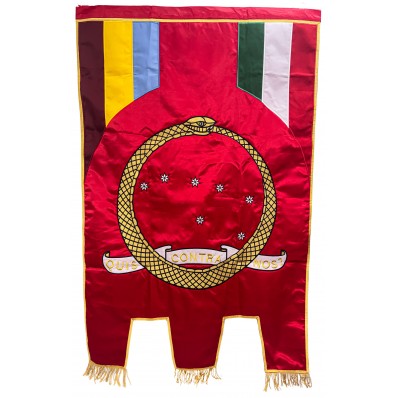


Regency of Carnaro Flag – Fully Embroidered
New
Flag of the Regency of Carnaro, fully embroidered and faithfully reproduced from the original historical design in every detail. It depicts the official flag adopted by Gabriele D’Annunzio’s government in Fiume, featuring the Ouroboros and the Star of Carnaro.
Warning: Last items in stock!
- Satisfied or refunded: we guarantee 100% secure protection on your purchases
- Free return: return your order free of charge within 30 days from receipt
- Secure payments: pay securely online with PayPal or credit cards

More info
The Flag of the Regency of Carnaro is one of the most distinctive political flags of post-First World War Italy. It became the official state flag of the Italian Regency of Carnaro, proclaimed by Gabriele D’Annunzio in Fiume on 8 September 1920 following the occupation of the city by Italian volunteers the previous year.
Its symbolism is particularly elaborate. At its centre appears the Ouroboros, the ancient serpent biting its own tail, representing eternity, continuity and renewal. Enclosed within the circle is the Star of Carnaro, the official emblem of the Regency. The entire composition is placed upon the Italian tricolour, reflecting the state’s declared cultural and national connection with Italy.
The Regency of Carnaro became one of the most unusual political experiments of twentieth-century Europe. Its constitutional charter, the Charter of Carnaro, was drafted primarily by Alceste De Ambris and later revised by D’Annunzio. It combined republican, corporative and democratic concepts while assigning an unprecedented constitutional role to art and music, the latter being recognised as one of the fundamental principles of the state.
The experiment came to an end in December 1920 following the Treaty of Rapallo and the military intervention of the Kingdom of Italy during the events known as the Bloody Christmas, which concluded D’Annunzio’s administration after several days of fighting.
This version has been produced to an exceptionally high standard using full embroidery throughout the entire design. Every element of the Ouroboros, the Star of Carnaro and the surrounding details has been carefully reproduced to match surviving historical examples as closely as possible. Rather than relying on printed graphics, the complete embroidered construction recreates the appearance, texture and visual richness of the original historical flag, resulting in an exceptionally faithful reproduction.
Among its most interesting historical aspects is the lasting influence that the ceremonies, symbols and public rituals developed during the Fiume experience had on later Italian political imagery. At the same time, the Charter of Carnaro continues to be studied by historians and constitutional scholars as one of the most original constitutional experiments of twentieth-century Europe.
Data sheet
| Lenght | 160 cm |
| Width | 100 cm |
13 other products in the same category:

Flags
- Germany
- Uniforms
- Medals, Orders and Decorations
- Badges and Pins
- ID Tags
- Arm Shields
- Helmets
- Helmet Decals
- Visor Caps and Hats
- Cap and Helmet Badges
- Collar Tabs Badges
- Collar Tabs, Shoulder Boards and Epaulettes
- Arm Bands
- Division Cuff Titles
- Buckles And Belts
- Buttons For Uniforms
- Stamps
- Gorgets
- Rings
- SS Honour Ring in 925 Silver - Collector's Set
- Poletops
- Flags
- Daggers and Knives (Ornamental)
- Field Marshal Batons
- Field and Personal Equipment
- Service Watches
- Presentation Cases
- Documents and Award Letters
- Busts, Eagles, Lighters and Miscellaneous
- Croatian and Ustasha Militaria
- Denazified Articles
- Commemorative Necklaces
- Spare Parts, Small Parts and Accessories
- Italy
- Medals and Decorations
- Brevets And Badges
- Battle Shields and Tags
- Gorgets
- Visor Caps and Hats
- Cap and Helmet Badges
- Helmets Decals
- Friezes for Collar Tabs
- Collar Tabs, Shoulder Boards and Epaulettes
- Buckles
- Belts
- Buttons For Uniforms
- Rings
- Poletops
- Italian Resistance
- Keyrings
- Wallshields
- Daggers and Knives
- Flags
- Busts and Eagles
- Souvenirs
- Commemorative Necklaces
- Imperial Germany
- Soviet Union
- Other Countries